Iran's Revolutionary Guard fired ballistic missiles at two American warships on Saturday — an aircraft carrier and a guided-missile destroyer. Both evaded. No American was hurt.
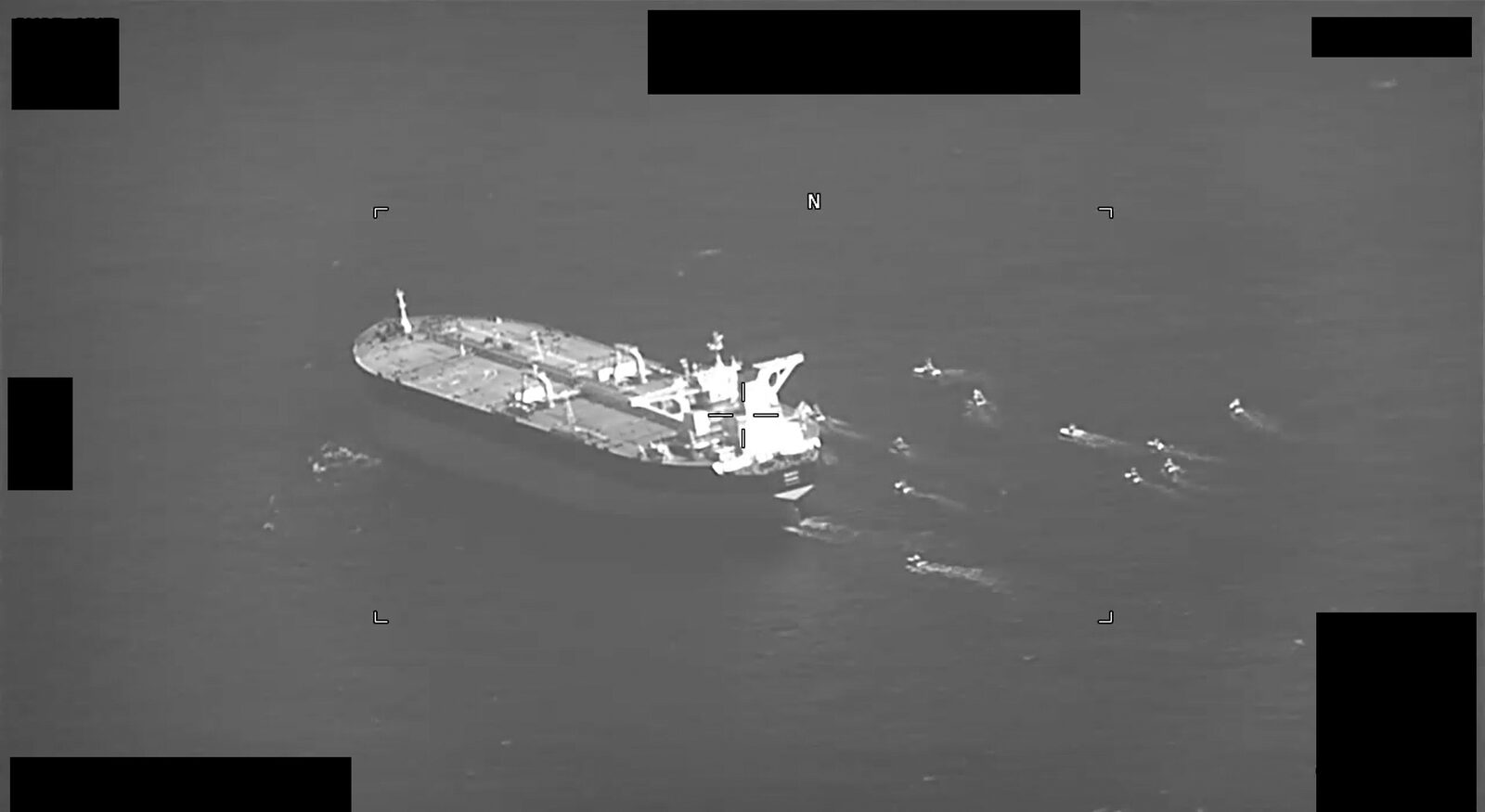
The United States did not strike back at the launchers. It struck three Iranian oil tankers: the M/T Downy off Kharg Island and the M/T Stark 1 near Jask, both permanently disabled, and the M/T Kylo in the Gulf of Oman, unladen, its crew directed to abandon ship before the vessel was hit.
Admiral Brad Cooper, who commands Central Command, described the exchange rate without euphemism. If you shoot at two of our ships, he said, we will impose an even higher economic cost — taking out three of yours.
The target was the income, not the shooter
That sentence is the story. A missile launcher is a military object and destroying it reduces the adversary's ability to fire again. A tanker is a revenue instrument. Destroying it reduces the adversary's ability to pay.
Those are different theories of retaliation. The first is attrition; the second is economic denial delivered by ordnance. The United States has run economic denial against Iran for decades through sanctions, and the distinguishing feature of sanctions is that they work through other people's decisions — banks that decline the transfer, insurers that decline the cover, buyers that decline the cargo. What happened on Saturday is the same objective pursued without the intermediaries.
Cooper's arithmetic — two of ours, three of yours — is the language of a cost curve rather than of a battlefield. It is also, deliberately, a published price. He is telling Tehran what the next round costs.
Both sides are now hitting tankers
This paper has spent the week on one side of that fact. Iran has attacked merchant shipping, expanded a blacklist to 56 named vessels that grows through ordinary commercial contact, and on Monday killed two Filipino seafarers aboard the Saudi tanker Sidr. Since February, thirty-one vessels carrying 421 Filipino crew have been attacked in incidents involving this strait.
As of Saturday, the other belligerent is also striking tankers.
The distinctions the United States would draw are real and should be stated. These were Iranian vessels, described as financing regional proxies rather than carrying third-party trade. The Kylo was empty. Its crew was warned and taken off before the strike. That is a materially different act from putting a missile into a laden ship with a working crew aboard, and anyone flattening the two is not describing what happened.
But the distinction that matters to a shipowner is narrower than the distinction that matters to a lawyer. What an underwriter now sees is a waterway in which two states are destroying commercial vessels, and in which the identity of a hull — its flag, its owner, its cargo, its last port — determines which of the two might destroy it.
What it does to the price
The mechanism is the one this desk described yesterday. Freight rates are set by the ratio of cargo seeking passage to tonnage willing to carry it, and everything that happened on Saturday reduces the willing side.
Rates were already extraordinary — over $200,000 a day for a very large crude carrier on the Gulf-to-Asia run, more than 440 percent up on the year, because the closure emptied the strait and made the remaining fleet enormously valuable. Saturday adds a second targeting authority to a market that had priced one.
It also removes the last argument for the escorts. A naval escort was never going to lower a war-risk premium, because an escort is not a contract and an underwriter cannot recover against a policy decision. Now the navy providing the escort is itself a participant in attacks on tankers, which does not make the escort less protective and does make the waterway harder to characterise for anyone writing cover on it.
The crews, again
The Kylo's crew were taken off. That was a decision somebody made and it was the right one, and it is worth recording that they made it.
The seafarers on the Downy and the Stark 1 are not accounted for in the reporting available at the time of writing. Neither is any Iranian response. Across the conflict, cumulative Iranian casualties have been put at more than 3,500 killed and more than 33,000 wounded.
Merchant crews are the constant in every version of this story. They are the people aboard when a state decides a ship is a legitimate expression of somebody's economy, and the ships can reroute while the people aboard them cannot.
What to watch next
Not the next strike. Watch whether Iran responds against merchant shipping rather than against warships.
The logic of Cooper's exchange rate is that Iran's cheapest available answer is not another missile at a carrier — that failed twice on Saturday — but the instrument it has been using all along against everyone else's tonnage. If the response comes against third-party merchant vessels, the United States will have established a price for attacking its warships and transferred part of the cost of that deterrent onto shipowners and crews who are not party to any of it.
That is the risk in publishing an exchange rate. It tells the other side what a round costs, and it does not tell them where to find the money.
The evasion of multiple ballistic missiles by a US aircraft carrier and guided-missile destroyer on 5 September 2026, the absence of US casualties, the strikes on the M/T Downy off Kharg Island and the M/T Stark 1 near Jask leaving both permanently disabled, the strike on the unladen M/T Kylo in the Gulf of Oman after its crew was directed to abandon ship, the attribution of the missile launches to the Islamic Revolutionary Guard Corps, and the quoted remarks of CENTCOM commander Admiral Brad Cooper are as reported by NBC News, CNN, CNBC, NPR and Stars and Stripes on 5 September 2026, citing US Central Command. The statement that the vessels help finance regional proxies is as reported by Al Jazeera the same day. Cumulative Iranian casualty estimates of more than 3,500 killed and more than 33,000 wounded across the conflict are as reported by Stars and Stripes. Accounts differ on whether the Kylo was destroyed or rendered inoperable; the more conservative description is used here. No independent Iranian account was available at the time of writing. The analysis is our own.
Topics worldhormuzshippingiranenergy