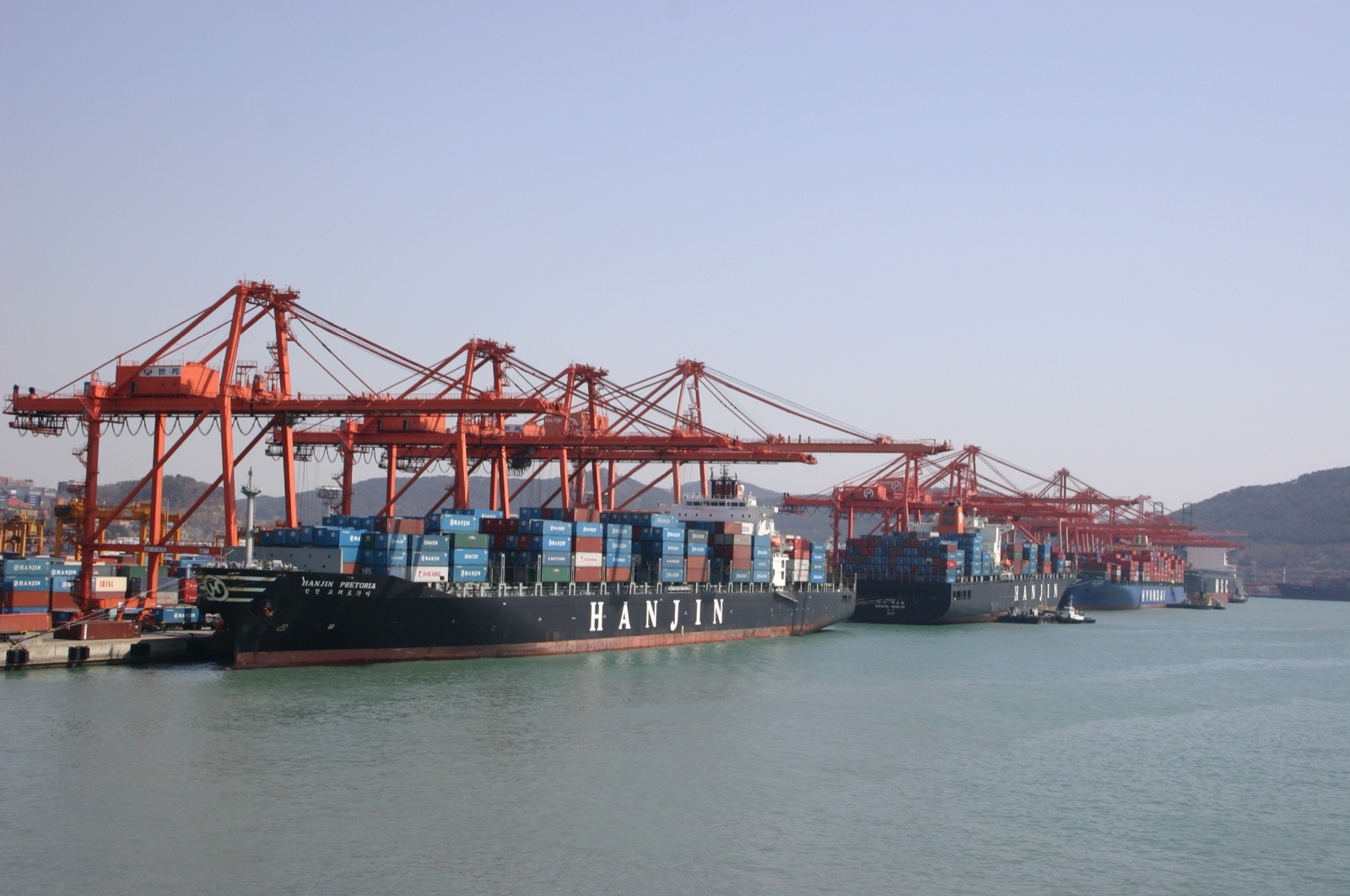
South Korea's exports rose 93.7 per cent from a year earlier to $115.28 billion in October, driven by a 259.4 per cent jump in semiconductor sales to $56.44 billion, the trade ministry said on Sunday. Chips made up 48.9 per cent of everything the country sold abroad.
It is the second-largest month on record, after September's $121.1 billion, Xinhua reported. The growth rate is the strongest since January 1974 and slightly above the 93.2 per cent median forecast in a Reuters poll of economists, Reuters reported. The number is enormous. Part of it is the calendar.
How much of the 93.7 per cent is the calendar?
Some, but not most. October 2025 contained most of the Chuseok harvest holiday, so it had fewer working days than this October. The Ministry of Trade, Industry and Energy's working-day-adjusted daily average was $5.24 billion, up 76 per cent, according to Seoul Economic Daily.
By this publication's arithmetic, those two figures imply about 22 working days this October against about 20 a year earlier. The extra days explain roughly 18 points of the 93.7 per cent headline. The other 76 points are real growth in what Korea sells per working day.
The early-month customs figures pointed the same way. In the first ten days of October, exports reached $26.1 billion and the daily average was a record $4.75 billion for any ten-day period, the Korea Customs Service said, as reported by Yonhap.
What drove the increase?
Chips, and the computers that hold them. Semiconductor exports rose to $56.44 billion and computer exports rose 496.6 per cent to $5.85 billion, the ministry's data show. Reuters tied the surge to the investment boom in artificial intelligence, the same data-centre demand behind the record quarter at U.S. memory maker Micron.
The ministry's figures allow a simple decomposition. This is our arithmetic, working back from the reported growth rates.
| October 2025 (implied) | October 2026 | Change | |
|---|---|---|---|
| Total exports | $59.5 billion | $115.3 billion | +$55.8 billion |
| Semiconductors | $15.7 billion | $56.4 billion | +$40.7 billion |
| Computers | $1.0 billion | $5.9 billion | +$4.9 billion |
| Everything else | $42.8 billion | $53.0 billion | +$10.2 billion |
Chips alone supplied 73 per cent of the dollar increase. Chips and computers together supplied 82 per cent. Exports excluding semiconductors rose 34 per cent, the ministry said, and 18 of the 20 largest export items grew; only ships and household goods fell. Cars reached $6.55 billion, up 18.1 per cent and the highest October on record, and electrical equipment such as transformers and cables set a monthly record of $1.99 billion.
The pattern is already visible in the wider economy. South Korea's economy grew faster than expected in the third quarter, driven by semiconductor exports and investment, Reuters reported. Imports of chipmaking equipment rose 49.2 per cent in October to $2.52 billion, The Asia Business Daily reported, a sign that manufacturers are still adding capacity rather than only selling down inventory. That is our reading of one import line, not a forecast.
So the rest of the economy's exports are growing. They are growing at about a third of the pace, and from a base that has not doubled.
Where did the goods go?
To both sides of the trade war. Exports to China rose 133.6 per cent to $26.98 billion, the fifth straight month above $20 billion, and exports to the United States rose 185.8 per cent to $24.9 billion, The Korea Times reported. Chip exports to the United States alone rose 497 per cent, according to The Asia Business Daily.
The China figure sits awkwardly beside China's own data. Its official factory survey showed manufacturing contracting in October, with new export orders at 48.7. One reading is that Chinese assemblers are buying Korean memory for AI servers and electronics regardless of weaker orders elsewhere. That is our inference; the ministry did not break down the China figure by product.
Imports rose 36 per cent to $72.78 billion, the fastest rise since January 2022, Reuters reported. Oil explains much of it. Crude imports fell 6.3 per cent by volume, but the unit price rose 62 per cent, lifting the bill 51.9 per cent to $10.7 billion, The Asia Business Daily reported. The trade surplus was $42.5 billion, below September's record $49.97 billion.
When does Korea reach $1 trillion?
Probably around 19 November. Exports for January to October totalled $930 billion, up 60.6 per cent, leaving $70 billion to go. "It is becoming certain that annual exports of $1 trillion will be reached," Kim Jung-kwan, the minister of trade, industry and resources, said, as quoted by Reuters. Korea would be the fourth country to pass that mark in a year, after the United States, China and Germany, Reuters reported.
At October's daily average of $5.24 billion, $70 billion takes about 13 to 14 working days. Counting from Monday 2 November, our arithmetic points to about 19 November, if the pace holds.
The more important test is concentration. When half a country's exports are one product sold largely to a handful of data centre builders, the trade figures become a reading on AI capital spending. The next one comes from the customs service's figures for the first ten days of November, due around 11 November. A slower daily average there would say more about the chip cycle than any headline growth rate.
October export, import, chip, computer, auto, daily-average and year-to-date figures are from the Ministry of Trade, Industry and Energy's preliminary data of 1 November 2026, as reported by Seoul Economic Daily, The Asia Business Daily, Reuters (via Yahoo Finance) and Xinhua on 1 November 2026. The Reuters poll median, the comparison with January 1974, September's growth rate and surplus, and Kim Jung-kwan's remark on the $1 trillion mark are as reported by Reuters. September's $121.1 billion figure is as reported by Xinhua; the Korea Times described October as a record, which the ministry's own ranking, as reported by Seoul Economic Daily and Xinhua, does not support. The crude oil import figures are from The Asia Business Daily. Early-October customs figures are from the Korea Customs Service via Yonhap, as published by The Korea Herald on 12 October 2026. The implied October 2025 figures, the working-day estimate, the contribution of chips and computers to the increase and the timing of the $1 trillion mark are this publication's arithmetic. The analysis is our own.
Topics worldexportstradesemiconductorsmemory chipsAIeconomic data