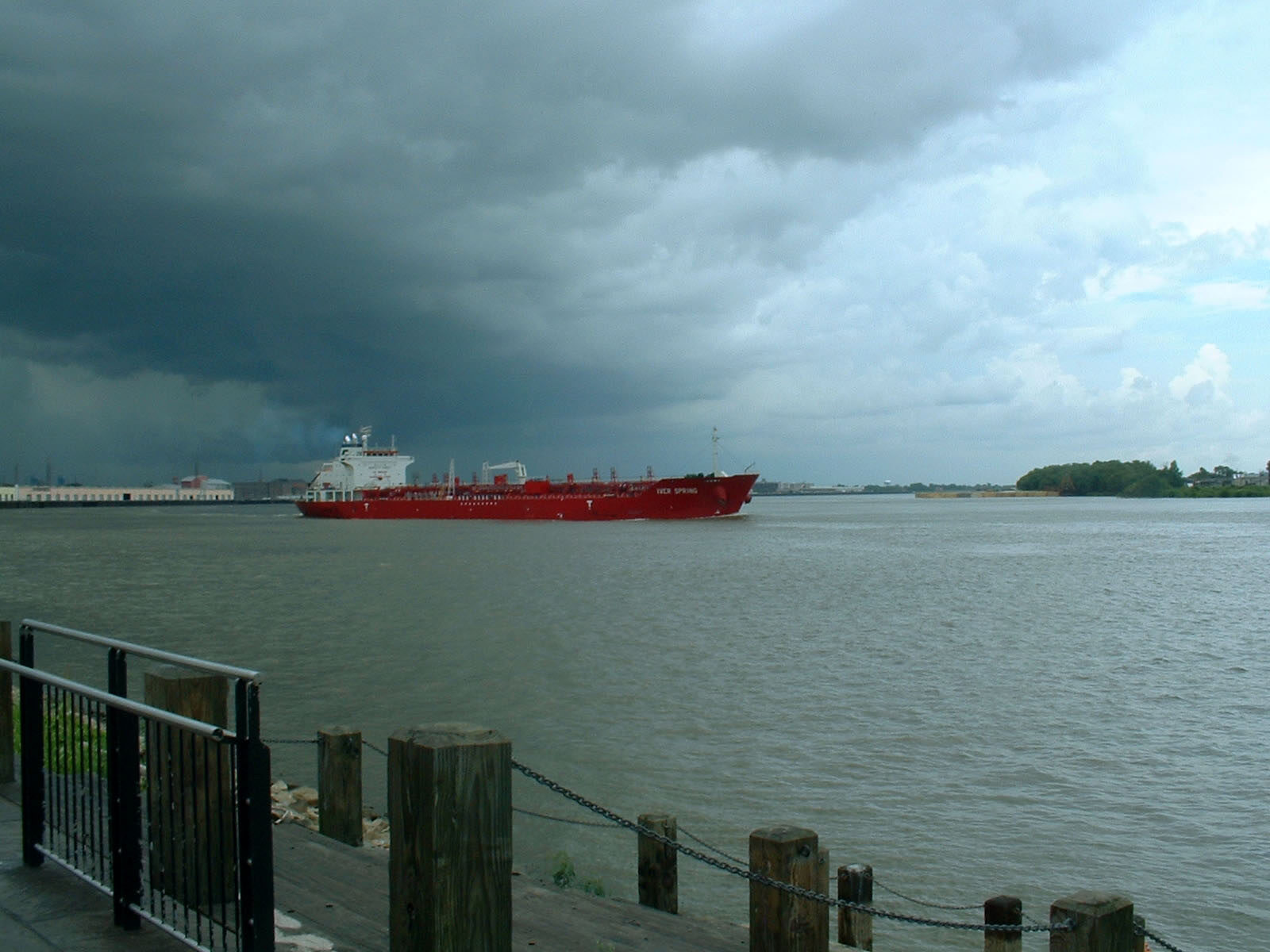
A 160-metre tanker carrying asphalt lost steering on the Mississippi River at New Orleans at about 12:30 p.m. on Friday, 13 November 2026, and struck the American Heritage, an American Cruise Lines paddlewheeler that had tied up two hours earlier and was letting its passengers off. The riverboat rolled onto its side against the dock. Everyone aboard survived, and 32 people were taken to hospital, none with critical injuries, WWNO reported.
The tanker is the Atlantic Asphalt. Its registered owner is Nave Shipping SA, according to the International Maritime Organization, and Nave Shipping is a subsidiary of China State Shipbuilding Corporation, the state-owned conglomerate, according to MarineTraffic, the Associated Press reported. By our reading of the federal notice, that ownership puts the ship squarely within a U.S. port fee on Chinese-owned vessels that would charge it about $347,600 a visit. The fee is not being collected. It was suspended again four days before the crash.
What happened on the river?
The Coast Guard's Capt. Melanie Burnham said the tanker appeared to have lost steering, according to the AP, and the National Transportation Safety Board is sending investigators. The accounts of how many people were aboard the American Heritage differ: about 130 according to the company and the port, as reported by WWNO, and 197 passengers and crew according to the AP. About 100 people went into 66-degree water when the boat rolled, the AP said. New Orleans Mayor Helena Moreno called it a "miracle on the Mississippi," WWNO reported.
The Coast Guard closed about three miles of the river to traffic, and the city's cross-river ferry stopped. The tanker has been towed away. Moving the riverboat could take weeks, beginning with removing its 16,000 gallons of fuel. The Board of Commissioners of the Port of New Orleans has sued Nave Shipping, saying the tanker did at least $1 million of damage to its terminal, and a judge issued a warrant on Friday giving federal officials control of the ship for now, the AP reported. China State Shipbuilding did not respond to the AP's request for comment.
What is the ship?
A mid-sized specialist tanker, built in China. The Atlantic Asphalt was launched in January 2017 at the Guangzhou Wenchong shipyard and measures 14,485 gross tons, 4,345 net tons and 17,764 tonnes deadweight, according to the ShipHotos register; VesselFinder lists it as a bitumen tanker under the Marshall Islands flag with the same gross tonnage and deadweight. The register's own owner entry is older and names a different company, Fortune Liwan Shipping, from 2017, so we rely on the IMO record the AP cited.
Net tonnage matters here because it is how the United States would bill the ship.
What would the U.S. port fee charge?
In April 2025 the U.S. Trade Representative, acting in a Section 301 investigation of China's shipbuilding and shipping practices, imposed a fee on any vessel with a Chinese operator or "owned by an entity of China." Under Annex I of the notice, an owner counts as Chinese if, among other tests, its "parent entity's headquarters" is in China, or if 25 per cent or more of it is held by the Chinese government. The fee is charged on a ship's first U.S. port on each visit, "up to five times per year, per vessel." Customs and Border Protection said in an October 2025 bulletin that net tonnage comes from the ship's International Tonnage Certificate and that "Annex I does not contain any exemptions or suspension of the fee."
Applying the published rates to the Atlantic Asphalt's 4,345 net tons gives the following.
| Rate takes effect | Fee per net ton | Per U.S. visit | Five visits a year |
|---|---|---|---|
| 14 October 2025 | $50 | $217,250 | $1,086,250 |
| 17 April 2026 | $80 | $347,600 | $1,738,000 |
| 17 April 2027 | $110 | $477,950 | $2,389,750 |
| 17 April 2028 | $140 | $608,300 | $3,041,500 |
For scale, the port says the ship did at least $1 million of damage to its terminal. Three visits a year at the current scheduled rate would cost more than that.
Two caveats. Whether a given ship qualifies is decided by CBP from the owner and operator named on its entry papers, not by a news report, and the AP's ownership chain comes from MarineTraffic. And because a ship built in China would otherwise fall under a second schedule, Annex II, it matters which annex applies; the notice says only one fee is charged, and CBP says the highest-priority criterion decides which.
Why is nobody paying it?
Because the fee has spent far longer suspended than in force. It took effect on 14 October 2025 and ran for 27 days. Under the trade deal President Donald Trump and President Xi Jinping announced on 1 November 2025, USTR suspended it from 10 November 2025 for a year. On 10 November 2026, USTR published a further suspension, effective 9 November, "through 11:59 p.m. Eastern Time on January 9, 2027," saying discussions with China "are ongoing." During the suspension, the notice says, "no party will accrue liability for or be required to pay the fees."
The crash came four days into that extension. When we wrote about container freight rates in October, a deferral was expected but not yet announced. It has now been granted twice.
Why it matters beyond one ship
The lower Mississippi is where a large share of this year's export growth leaves the country. We found last week that Texas and Louisiana account for 46 per cent of the rise in U.S. exports in 2026. A fee meant to change who owns and builds the ships calling there has, so far, changed very little, because it has barely been charged.
What to watch
The suspension ends at 11:59 p.m. on 9 January 2027, 57 days after the crash, unless USTR extends it again. The NTSB's preliminary findings on the loss of steering will come first. If the fee returns, the Atlantic Asphalt's next U.S. visit would be billed at $80 a net ton until 17 April 2027, when the scheduled rate rises to $110.
Crash details, times and casualty figures are from WWNO (13-14 November 2026) and the Associated Press as published by PBS NewsHour (14 November). Ownership is as the AP reported it from the International Maritime Organization and MarineTraffic. Tonnage, dimensions and build details are from the ShipHotos vessel register and VesselFinder, which agree on the gross tonnage and deadweight. Fee amounts, the five-a-year limit, the ownership tests and the per-string rule are from the U.S. Trade Representative's notice at 90 FR 17114 (23 April 2025). The suspension dates are from USTR's notice at 91 FR 72608 (10 November 2026). Payment and net-tonnage rules are from U.S. Customs and Border Protection's bulletin of 6 October 2025. Whether the fee would apply to this ship is our reading of the notice, not a determination by CBP or USTR. The fee calculations and day counts are this publication's arithmetic. The analysis is our own.
Topics businessshippingtankersSection 301Chinatrade