Federal investigators are working on why a Boeing 767 freighter left the end of runway 30 at Miami on Sunday afternoon at something close to 130 miles an hour, struck vehicles and burned. Five people were killed. None of them were on the aeroplane.
Video of the landing has since been described as showing the aircraft still airborne well down the runway before it touched down.
The NTSB will take a year or more and nothing about cause is established. But that one observation is worth explaining now, because it is the variable that quietly determines everything else about an overrun, and it is routinely reported as a detail rather than as the mechanism.
Landing distance is a subtraction
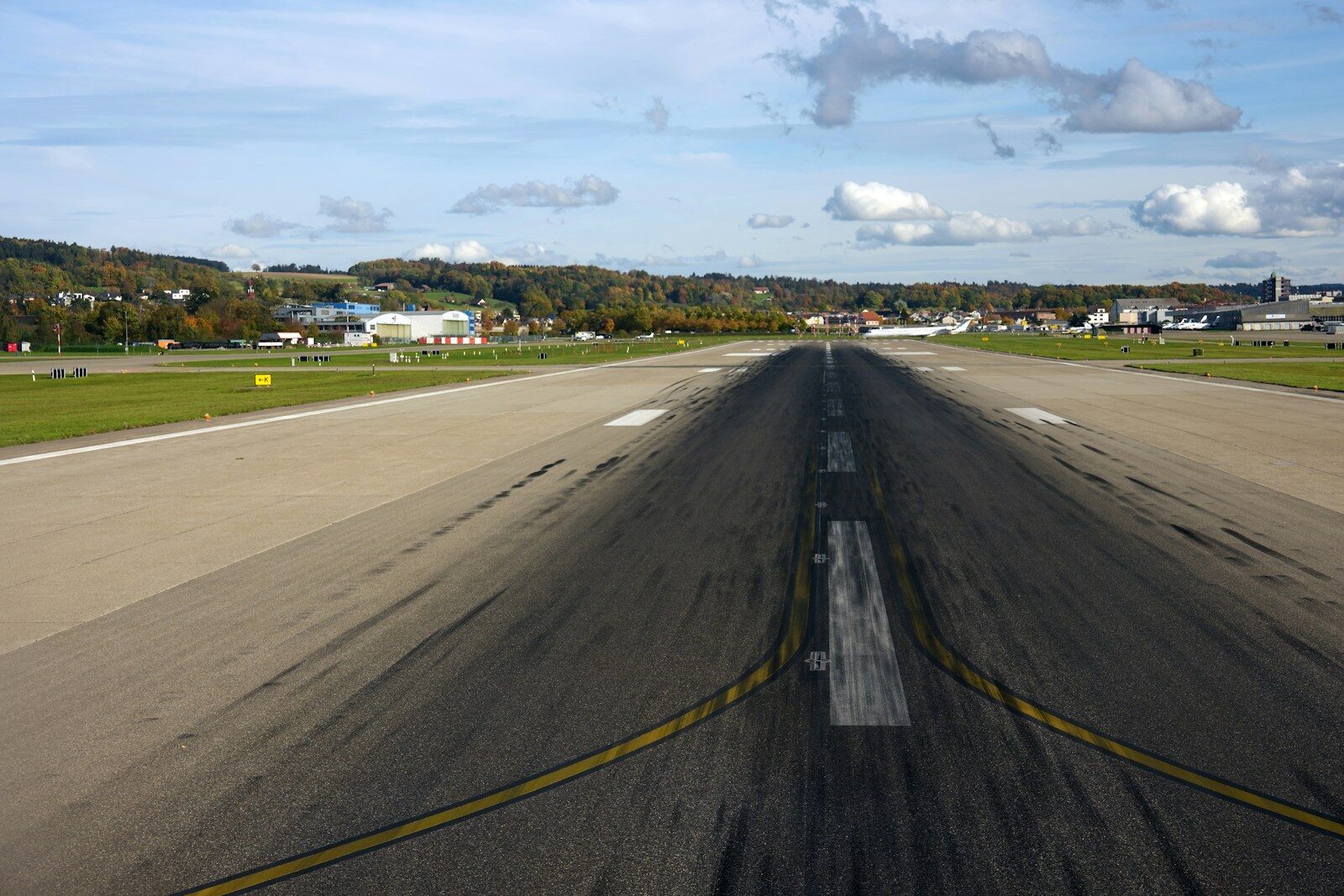
A runway is a fixed length. An aircraft's stopping performance is calculated from the touchdown point, not from the threshold.
Every foot flown past the aiming point is a foot removed from the distance available to stop in, and it is removed at the worst possible moment — before the wheels are down, before the spoilers deploy, before autobrake or reverse thrust can do anything at all. A float of a thousand feet on a runway with two thousand feet of margin does not consume half the margin. It consumes the half that the deceleration curve needed most, because braking is least effective at the highest speed and the highest speed is at the start.
That is why a long landing appears in overrun investigations far more often than brake failure does, and why the industry's counter-measure is not better brakes but a rule about when to stop trying: if the aircraft is not on the ground within a defined zone, go around.
Why an aircraft floats
Several ordinary reasons, none of them exotic and all of them things the investigation will now measure.
Excess speed over the threshold. A tailwind component, which lengthens the ground roll and can flatten the approach. A high or fast approach that arrives with energy the aircraft has to dissipate before it can be put down. A runway surface that is wet or contaminated, which does not cause a float but shrinks the margin the float eats into. Any of these individually is survivable. Together they subtract from the same number.
For a freighter the weight question is also live. A cargo aircraft's landing weight varies enormously with the load, and the calculation that says a given runway is sufficient is made against a figure supplied before departure.
What this does and does not say about the earlier question
This desk wrote yesterday that the aircraft wore Prime Air livery and was operated by 21 Air, that Amazon holds no FAA operating certificate, and that crew training, duty time, dispatch and maintenance all sit with the carrier rather than the brand.
A long float sits squarely inside that boundary. Approach speed, stabilisation criteria, go-around discipline and the training that enforces them are operator functions. If the eventual finding turns on the approach, it will land on 21 Air, and the contracting customer will be exactly as far from it as the certificate structure implies.
The one thread that could cross back is schedule. Whether an approach was rushed is a question about pressure, and pressure in an ACMI arrangement is written into a contract by somebody else. That is a much harder thing to establish than a groundspeed, and it is the reason the recommendations will be more interesting than the cause.
The five who died are a separate question
They were in vehicles.
Whatever the investigation finds about the approach, the reason a landing error became five deaths is what lay past the end of the runway — the runway safety area, whether an engineered arresting system was installed, and how close the road runs. Those are questions for the airport authority and the FAA, and they are independent of anything the crew did.
An overrun that stops in a safety area is an incident with a damaged aeroplane. The same overrun with a road at the end is what happened on Sunday.
What to watch
Not the cockpit voice recorder, which will be read early and not published.
Watch for the NTSB's preliminary report in about thirty days, and specifically for two numbers in it: the touchdown point relative to the threshold, and the groundspeed crossing it. Those two figures, together with the runway length, will tell any reader whether the aircraft could have stopped — and they will be published long before anybody explains why it did not.
The overrun of runway 30 at Miami International Airport on 6 September 2026 by a Boeing 767 freighter operating as Prime Air flight 7598; the five deaths and five injuries including both pilots; the fact that those killed were not aboard the aircraft; the operation of the flight by 21 Air of Greensboro, North Carolina; and the description of video appearing to show the aircraft remaining airborne well down the runway before touchdown are as reported by the Associated Press, Bloomberg, ABC News, NBC News and CNN on 6, 7 and 8 September 2026, and the groundspeed figure of close to 130mph on leaving the usable runway is as indicated by Flightradar24 data. The NTSB has not published findings, no cause has been determined, and none is asserted here. The general aerodynamics of landing distance are standard and are our own exposition.
Topics businessaviationsafetylogisticsntsb