The commercial case for northern shipping is straightforward and has been for years. A container moving between north-east Asia and northern Europe over the top of Russia covers roughly a third less distance than it does through Suez, and distance is fuel, time and charter cost. As summer ice retreats, the window in which that arithmetic works has been lengthening.
What has not lengthened is the capacity to operate in the water the arithmetic depends on. A shipping lane is not a line on a chart. It is escort capability, current hydrographic survey, salvage and rescue coverage, and somewhere to take a damaged hull. Along most of the northern routes, all four are thin or absent, and the asset that provides the first of them is the one nobody built.
The fleet is a rounding error, and the shipyard queue is the reason
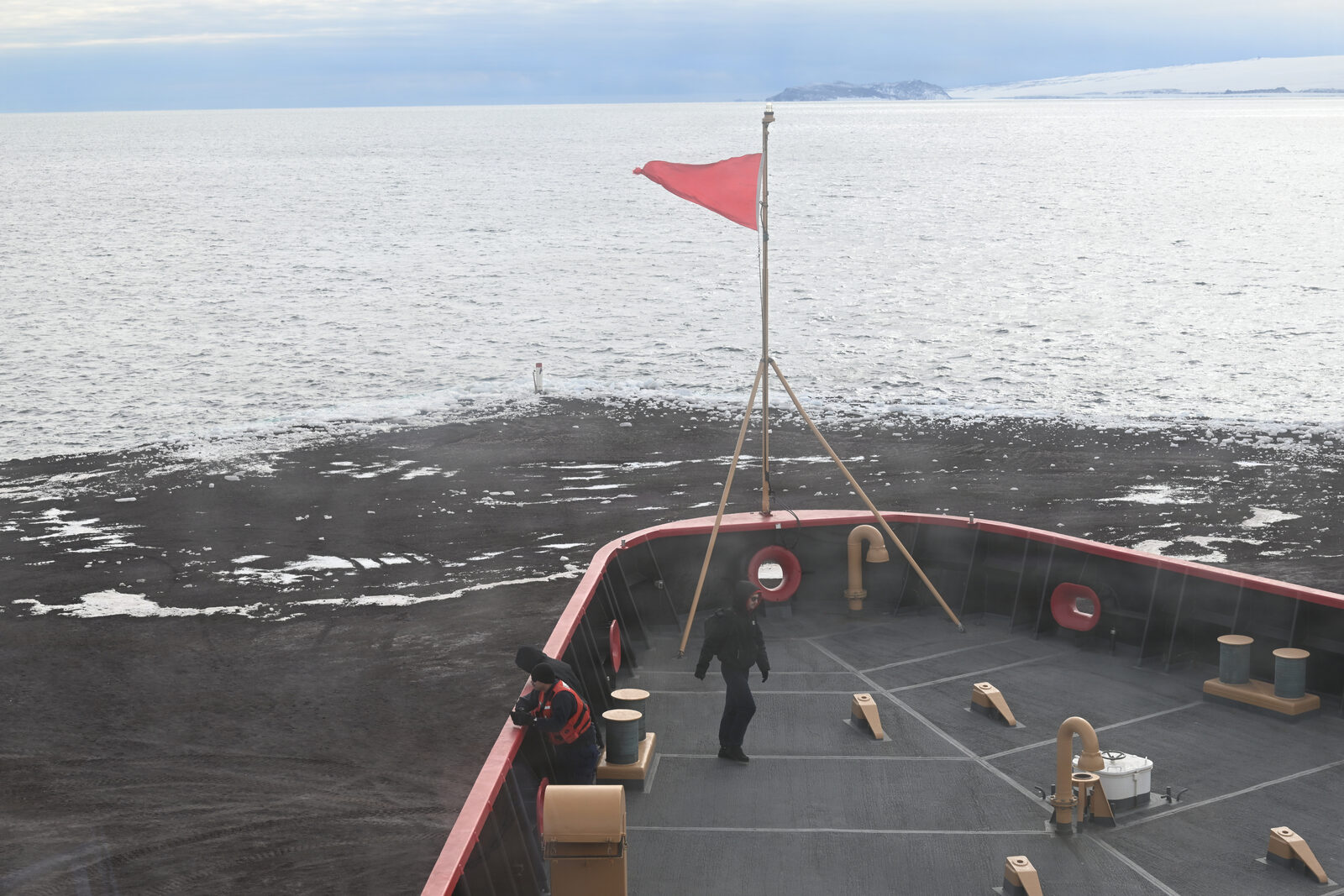
The United States operates one heavy polar icebreaker. It was commissioned in 1976, and it spends its operational season in the Southern Ocean, breaking the channel that resupplies the American research station in Antarctica — a commitment that recurs annually and cannot be skipped without stranding a continent's worth of science. The practical consequence is that the ship most capable of working Arctic ice is, for much of the year, at the other end of the planet.
Russia operates dozens, including nuclear-powered vessels purpose-built to keep a commercial route open through winter, and it charges for the escort. That is the actual asymmetry: not a military one, but a tolling one. The country with the icebreakers decides the terms on which anyone else's cargo moves.
Fixing this is a shipyard problem, and shipyard problems run on decade timescales. A heavy icebreaker is a small production run of an unusual hull, ordered by one customer, requiring a workforce that has not built one recently. Every country attempting it has discovered the same thing: the first vessel of a restarted line costs far more and takes far longer than the estimate, because the estimate priced steel and not the relearning. The programmes now under way in several countries are all late by the standards of their own announcements.
The pattern is familiar from any infrastructure a country stops building for a generation. Capability is not a stock that sits idle waiting to be drawn on; it is a flow that decays when unused, and restarting it means paying to rebuild the flow before anything gets delivered. This is the same discovery states have been making about their own approval processes — that the gap between a funded project and a finished one is mostly institutional, and that money arrives long before the capacity to use it does.
Commercial operators have drawn the sensible conclusion and are hedging. Ice-class newbuilds are being ordered, but slowly and in small numbers, because a vessel strengthened for ice is more expensive to build and less efficient everywhere else, and no operator wants a fleet optimised for a route whose insurance terms are still unsettled. Underwriters, for their part, are pricing the absence of rescue coverage rather than the presence of ice, which is insurance behaving as infrastructure policy by another route.
So the route opens on the satellite images and stays mostly empty in the manifests. The cargo that does move is bulk rather than containers, because bulk can absorb a schedule that containers cannot — the same logic that has kept nearshoring a freight story rather than a conference story, and that keeps the constraint on ports sitting behind them rather than at the berth.
The ice is doing its part on a schedule nobody controls. The hulls are on a schedule that was set thirty years ago, by deciding not to order any, and the long-term gas contracts that financed the terminals are being reopened.
Topics worldshippingarcticinfrastructuretrade