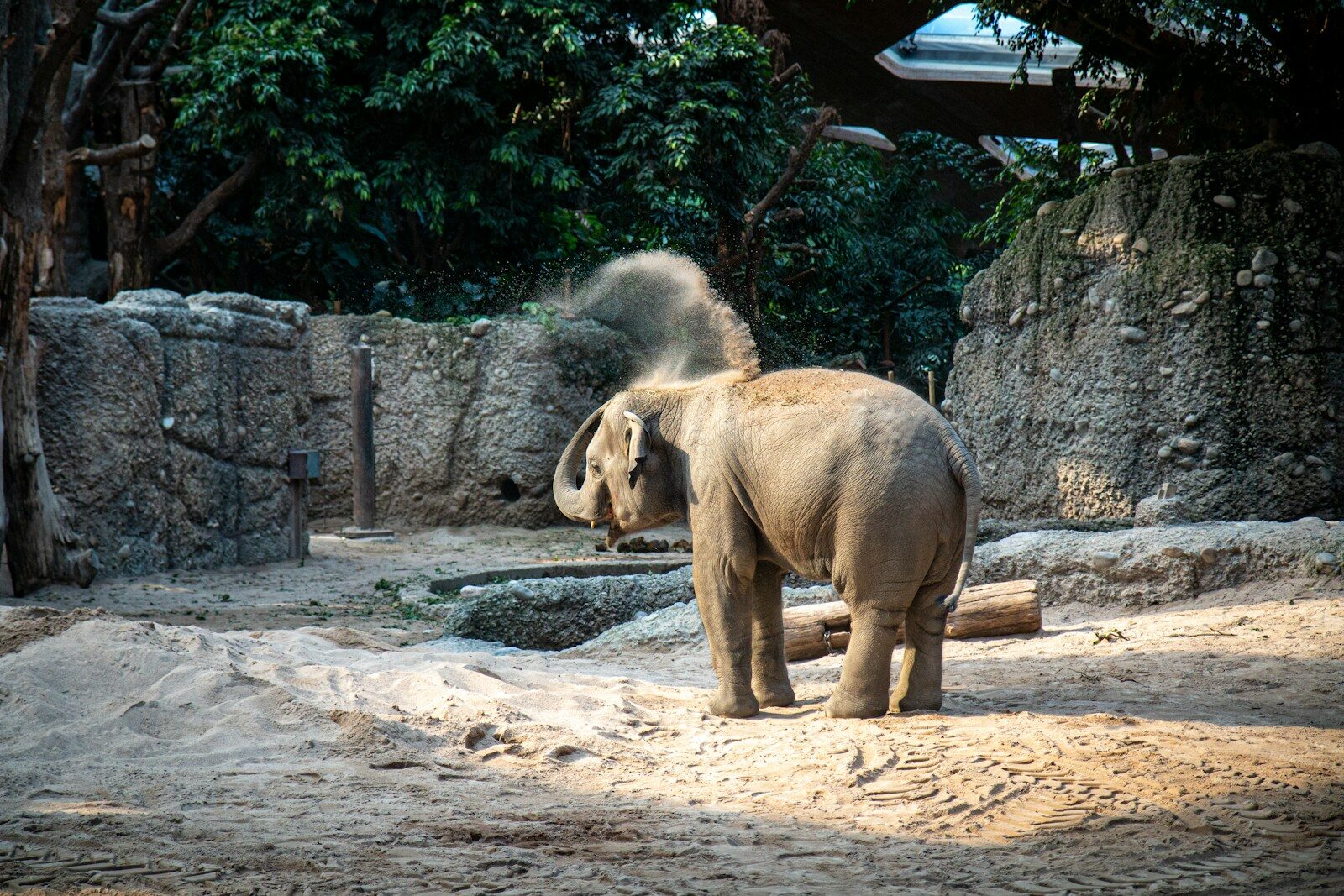
An elephant is a simple thing for a government to accept. Sri Lanka offered one, the Philippines took her, and a calf arrived in Manila in the late 1970s as a symbol of friendship between two states. No procedure was required beyond the acceptance itself. She was named Vishwa Ma'ali, became Mali, and lived at the Manila Zoo for the whole of her life.
Getting her out again turned out to require something nobody had built. For years campaigners — PETA most visibly — pressed for her transfer to a sanctuary in Thailand or in Tennessee. The government did not approve it, citing a genuine and not obviously wrong concern that an animal who had lived her entire life in one enclosure might not adapt to another. Mali died at the zoo on 28 November 2023, of congestive heart failure, somewhere between 43 and 49 years old. On 27 August she reappeared, taxidermied, in a case at the National Museum of Natural History.
Acquisition is an event; release is a mechanism
The instinct is to read this as cruelty, and the emotional force of the story comes from reading it that way. The institutional reality is duller and, in its way, worse. Accepting an animal is a single decision made by people who are present and enthusiastic. Releasing one is a process: it needs a receiving institution, an export permit, a veterinary sign-off, a transport plan, money, and — the part that actually fails — an official willing to own the outcome if the animal dies in transit or fails to settle.
Nobody is blamed for an elephant who stays. Somebody is blamed for an elephant who leaves and does not thrive. Faced with that asymmetry, an institution does not need malice to arrive at inaction. It only needs the absence of a rule that says who decides, on what evidence, and by when.
This is the same structural failure this publication keeps finding in other places, and it is worth naming as one rather than treating each instance as a scandal of its own. A succession fight is a design failure for exactly this reason: the institution never wrote down how power transfers, so the transfer becomes a fight. The local museum discovers its collection is a liability because accessioning is easy, cheap and celebrated, while deaccessioning is slow, contested and career-limiting — so the holdings only ever grow. The pattern is not about animals or objects. It is about organisations that build an intake and never build an exit.
What makes Mali's case sharp is that the same institution now decides how she is remembered. Manila's tourism and culture department describes the exhibit as honouring her life. The campaign group EnviSay has argued her story should not end with her becoming another exhibit, and PETA has said her confinement should not be celebrated. Both readings can be held at once: a museum specimen is a legitimate object of natural history, and this particular specimen is the animal whose confinement was the point of contention.
There is a version of the exhibit that would resolve the tension, and it costs nothing to build. It would say on the card how long she lived alone, what was proposed, who decided against it, and why. Institutions are usually willing to display an animal and almost never willing to display the decision that shaped its life. A cemetery runs on a fund that stopped working long before anyone noticed, because perpetual care is a promise nobody is accountable for keeping; a permanent exhibit is the same kind of promise, and it deserves the same scrutiny.
Mali cannot be given the sanctuary years now. What can still be decided is whether the case in Manila records an animal or records what happened to her — and that, unlike the transfer, requires no permit from anyone.
Details of the exhibit and its opening are as reported by Interaksyon, GMA News and the Manila Bulletin; the necropsy finding, the arrival, and the campaigns to relocate her are drawn from those accounts and the public record. Statements attributed to the Department of Tourism, Culture and Arts of Manila, to PETA and to EnviSay are as those organisations made them. The analysis is our own.
Topics worldphilippinesinstitutionsmuseums