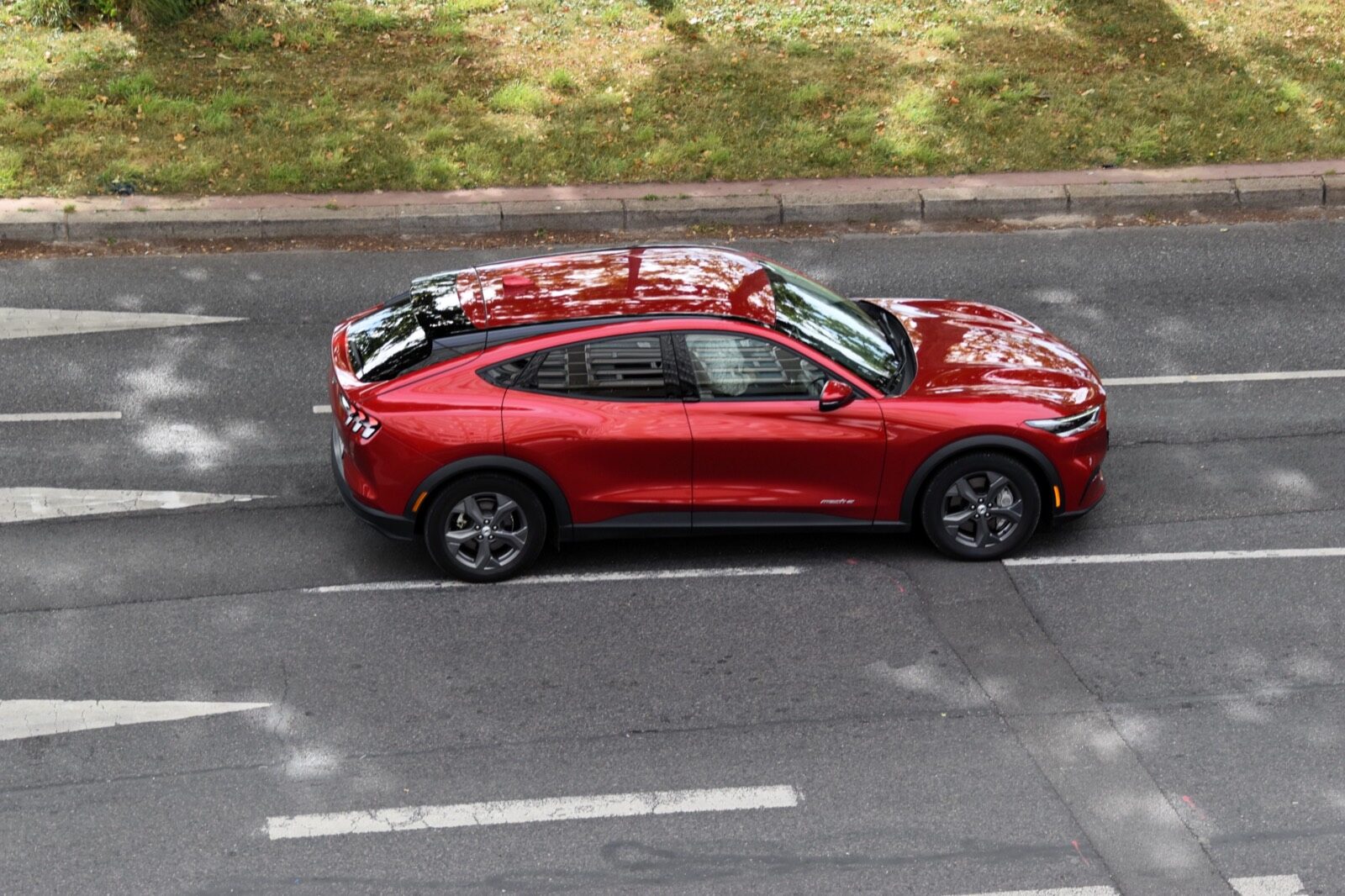
Ford's electric-vehicle division, Model e, lost $1.06 billion before interest and taxes in the third quarter, 25 per cent less than a year earlier, Ford said on Wednesday. It shipped 34,000 vehicles, down from 50,000. By this publication's arithmetic, the loss per vehicle shipped rose to about $31,000 from about $28,200.
The company as a whole did better than its EV unit. Adjusted earnings before interest and taxes rose to $2.7 billion from $2.6 billion on revenue down 2 per cent to $49.5 billion, and Ford raised the bottom of its full-year forecast. "Ford delivered a strong quarter," said Jim Farley, the president and chief executive.
Why did the loss per vehicle rise?
Because sales fell faster than costs. Model e revenue dropped 31 per cent to $1.2 billion, in line with volume, while the loss shrank by $352 million. Ford says the segment is cutting the cost of its first-generation vehicles while investing in a cheaper electric platform, which it calls the Universal Electric Vehicle, and in Ford Energy, a battery-storage business. That investment sits inside the loss, so the per-vehicle figure is not a production cost: it measures what the division costs Ford for each vehicle it currently ships.
The broader market explains much of the volume. U.S. electric-vehicle sales fell about 30 per cent through September after the federal tax credit expired, and buyers moved to hybrids, as Toyota's gains on GM showed.
| Third quarter | 2025 | 2026 |
|---|---|---|
| Model e wholesales | 50,000 | 34,000 |
| Model e revenue | $1.8 billion | $1.2 billion |
| Model e EBIT | -$1,410 million | -$1,058 million |
| Loss per vehicle shipped (our arithmetic) | about $28,200 | about $31,100 |
| Ford Blue EBIT | $1,540 million | $1,392 million |
| Ford Pro EBIT | $1,985 million | $1,665 million |
| Ford Credit earnings before taxes | about $632 million | $803 million |
Source: Ford third-quarter 2026 release, 28 October 2026. Wholesales include some vehicles built and sold by unconsolidated affiliates. Ford Credit's 2025 figure is derived from the 27 per cent increase Ford reported; per-vehicle figures are this publication's arithmetic.
Where did Ford make its money?
In trucks, vans and lending, though less than a year ago in the first two. Ford Pro, the commercial-vehicle business, earned $1.67 billion, down 16 per cent, which Ford attributed to commodity costs and launch costs for Super Duty production at Oakville, Ontario, partly offset by lower tariffs. Ford Blue, its gas-powered and hybrid business, earned $1.39 billion, down 10 per cent, on discontinued products, the effect of the Middle East conflict in that region and higher commodity prices. Ford Credit's pre-tax earnings rose 27 per cent to $803 million.
Two costs run through the year. Sherry House, the chief financial officer, said on the earnings call that Ford had incurred "about $1 billion in Novelis-related temporary costs year-to-date," tied to its aluminium supplier, with more to come in the fourth quarter. The forecast also assumes commodity headwinds approaching $2.5 billion against last year, and excludes a significant escalation in the Middle East.
What does the forecast imply for the fourth quarter?
A quarter roughly like this one. Ford now expects 2026 adjusted EBIT of $10.5 billion to $11 billion, against $10 billion to $11 billion before, and has earned $8.6 billion in nine months. By this publication's arithmetic, that leaves $1.9 billion to $2.4 billion for the fourth quarter. Model e has lost $2.75 billion so far; Ford's unchanged full-year forecast of about $4 billion implies about $1.25 billion more, the largest quarterly loss of the year. Free cash flow guidance stayed at $6 billion to $7 billion.
Ford says the turn comes with its next product. Andrew Frick, president of Ford Blue and Model e, said on the call that the Fathom, which Farley called Ford's first vehicle off the new platform, will start at $28,350. Farley said the launch, at Ford's Louisville plant, remains on track for the fourth quarter of 2027. House said Ford is still targeting break-even for Model e by 2029. General Motors' U.S. sales fell 6 per cent in the same quarter.
What to watch
The fourth-quarter Model e loss against the implied $1.25 billion, and whether Fathom's price holds through launch. The per-vehicle arithmetic will not improve while volumes fall; it improves only if the new platform both costs less to build and sells in numbers the current models no longer do.
Segment and company results, wholesales, guidance, the dividend, the assumptions behind the forecast and the quotes from Jim Farley and Sherry House in the opening section are from Ford's third-quarter release of 28 October 2026. The Novelis cost figure, the Model e break-even target, the Fathom price and launch timing and the Ford Energy remarks are from the earnings call on 28 October 2026, as transcribed by The Motley Fool. The per-vehicle figures and implied fourth-quarter numbers are this publication's arithmetic. The analysis is our own.
Topics businessFordelectric vehiclesearningsautoscommodities