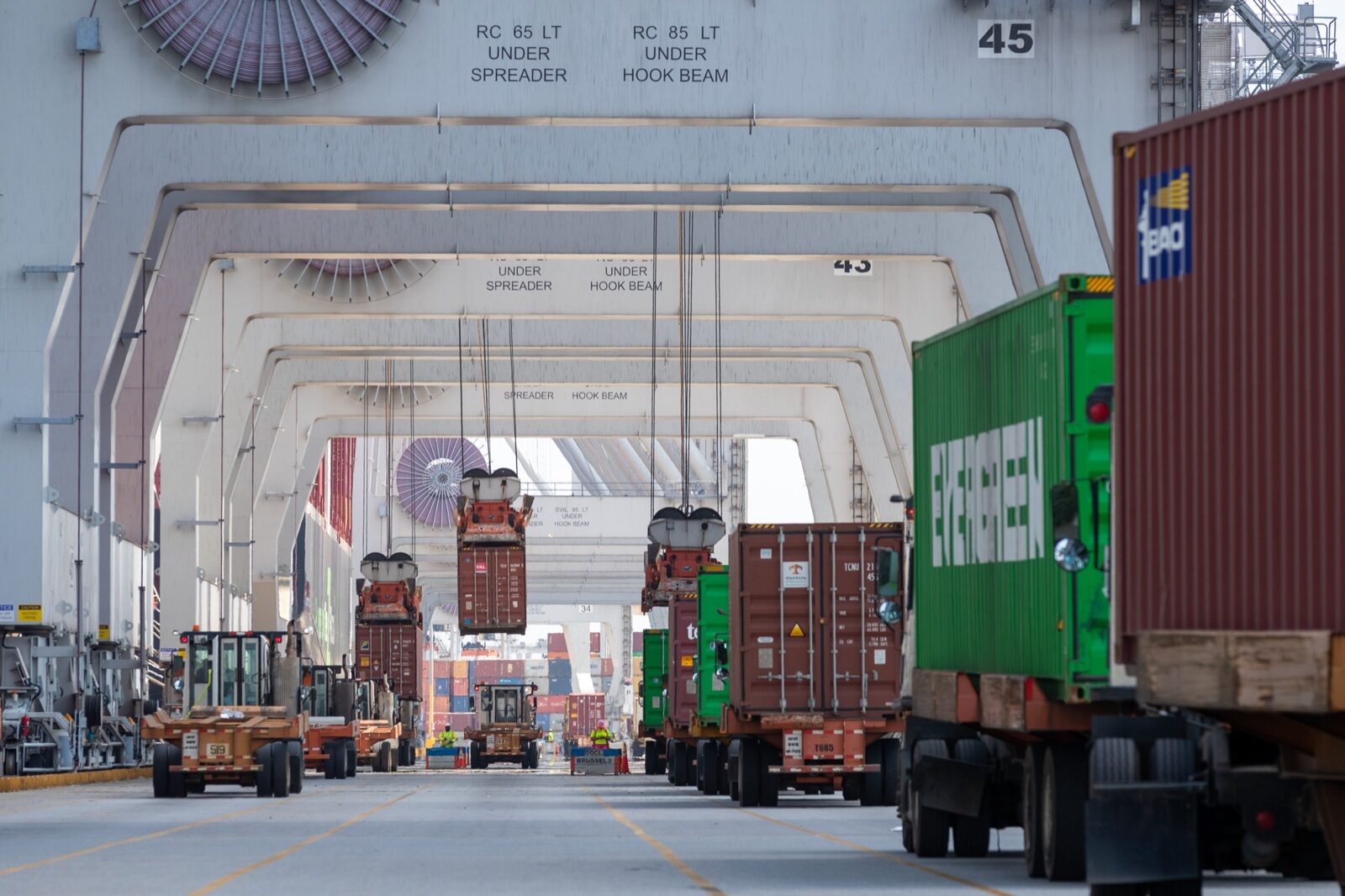
The United States bought $420.8 billion of goods and services from the rest of the world in August, according to figures published on Tuesday by the Census Bureau and the Bureau of Economic Analysis. It is the most in any month since the monthly series began in 1992. The previous high, $416.4 billion, was set in March 2025, the month before the administration announced its "reciprocal" tariffs.
Exports rose as well, to $315.2 billion, but by less. The deficit widened by $12.7 billion to $105.6 billion, the largest since that same March. Economists surveyed by Bloomberg had expected a shortfall of about $102.1 billion.
The two records look alike on a chart. They are made of different things.
Not the same rush
In March 2025 the surge was in consumer goods. Importers brought in $101.6 billion of them that month, on the Census basis the release uses for its product detail. In August 2026 they brought in $57.5 billion.
What has taken their place is capital goods: the machines, equipment and components businesses buy to produce things rather than to resell. Imports of capital goods, excluding vehicles, were $93.1 billion in March 2025. In August they were $146.4 billion, $53.7 billion or 58 per cent more than in August last year.
Capital goods made up 43.6 per cent of the goods the country imported in August, up from 35.3 per cent a year earlier. Of the $73.2 billion by which monthly goods imports grew over that year, they accounted for almost three-quarters.
The month itself added to the pattern. Semiconductor imports rose by $2.4 billion from July, which Bloomberg reported was the largest monthly increase on record. Imports of crude oil rose by $3.3 billion and of non-monetary gold by $3.1 billion. Adjusted for prices, the goods deficit widened by 8.2 per cent to $114.7 billion.
Four lines of hardware
The release's commodity tables show how concentrated the change is. Over the first eight months of the year, against the same months of 2025:
- Imports of computers rose to $255.0 billion from $130.9 billion, close to double.
- Computer accessories rose to $158.5 billion from $89.5 billion.
- Telecommunications equipment rose to $111.6 billion from $72.9 billion.
- Semiconductors rose to $90.5 billion from $49.2 billion.
Together those four lines are up $273.0 billion. Imports of all goods are up only $96.9 billion over the same period. All the other goods the United States buys from abroad, from medicines and furniture to steel and coffee, are therefore down by about $176 billion, or 8.8 per cent.
Some of that fall reflects how distorted last year was. The largest single drop is in pharmaceutical preparations, down $90.8 billion, or 44 per cent, to $115.1 billion. Another category, finished metal shapes, was $96.5 billion in the first eight months of 2025 and is $20.8 billion this year. Strip out pharmaceuticals and consumer goods imports are still 5.8 per cent lower than a year ago. Imports of furniture, household appliances and cotton apparel are all down.
The change is not that Americans have stopped importing. It is that the money is going on a different kind of good, from a different set of suppliers.
Who sells it
August's largest bilateral goods deficits were with Mexico, at $27.7 billion, Vietnam, at $24.0 billion, Taiwan, at $18.3 billion, and China, at $16.4 billion. Bloomberg reported that the deficits with Mexico and Vietnam were records and that the shortfall with Taiwan, a principal supplier of semiconductors, also grew. China's own figures for its trade with America have diverged sharply from Washington's this year.
The deficit with Canada rose by $4.1 billion to $7.1 billion, as imports from Canada jumped by $4.6 billion to $37.1 billion. Companies in both countries brought shipments forward after trade talks broke down in August, Bloomberg reported, ahead of 50 per cent tariffs on billions of dollars of Canadian goods that took effect on 22 August. That is the older kind of rush, and it is a small part of this month's total.
The other side of the ledger
Over the year as a whole the picture is less lopsided. Through August, exports are up $267.7 billion, or 11.8 per cent, and imports up $129.5 billion, or 4.4 per cent. The cumulative deficit is $138.2 billion, or 19.9 per cent, smaller than in the same months of 2025, when monthly deficits of between $117 billion and $133 billion in January, February and March inflated the total.
Part of that improvement is oil. Petroleum exports were $230.8 billion in the first eight months, against $167.8 billion a year earlier, as prices rose. The petroleum surplus was $9.4 billion in August, down from $17.8 billion in April but well above $3.5 billion in August 2025.
What it does to growth
The arithmetic of gross domestic product counts an imported server once as business investment and subtracts it again as an import. It adds to measured output only through the domestic work done to ship, install and run it. When imports of equipment rise this fast, trade shows up as a large drag on growth even while investment looks strong.
Before Tuesday's figures, the Atlanta Fed's GDPNow model estimated that net exports would subtract 2.59 percentage points from third-quarter growth, Bloomberg reported, the most since early 2025. Bloomberg said the August deficit would likely weigh on third-quarter output.
Matthew Martin, senior US economist at Oxford Economics, has attributed the rise in capital goods imports to business spending on high-tech equipment, and expects it to keep import growth strong well into 2027, Quartz reported.
That makes the August record a measure of where American investment is going, and of how much of it is built abroad. Last year's record was households and retailers buying ahead of a tax. This year's is companies buying hardware.
The figures for September are due on 4 November.
All trade figures are from "U.S. International Trade in Goods and Services, August 2026" (release CB 26-160, BEA 26-44), published by the Census Bureau and the Bureau of Economic Analysis on 6 October 2026, and its Exhibits 1, 6, 8 and 9. Headline and country figures are seasonally adjusted on a balance-of-payments basis; end-use and commodity detail is on a Census basis, as the release presents it. The record comparison uses the monthly imports series BOPTIMP on FRED, which begins in January 1992. The economists' consensus, the GDPNow estimate, the record monthly rise in semiconductor imports and the Canada tariff date are from Bloomberg's report of 6 October 2026. Matthew Martin's view is as reported by Quartz the same day. The shares, the year-to-date sums by commodity, the residual for all other goods and the comparison with March 2025 are this publication's calculations. Accurate to noon ET on 6 October 2026.