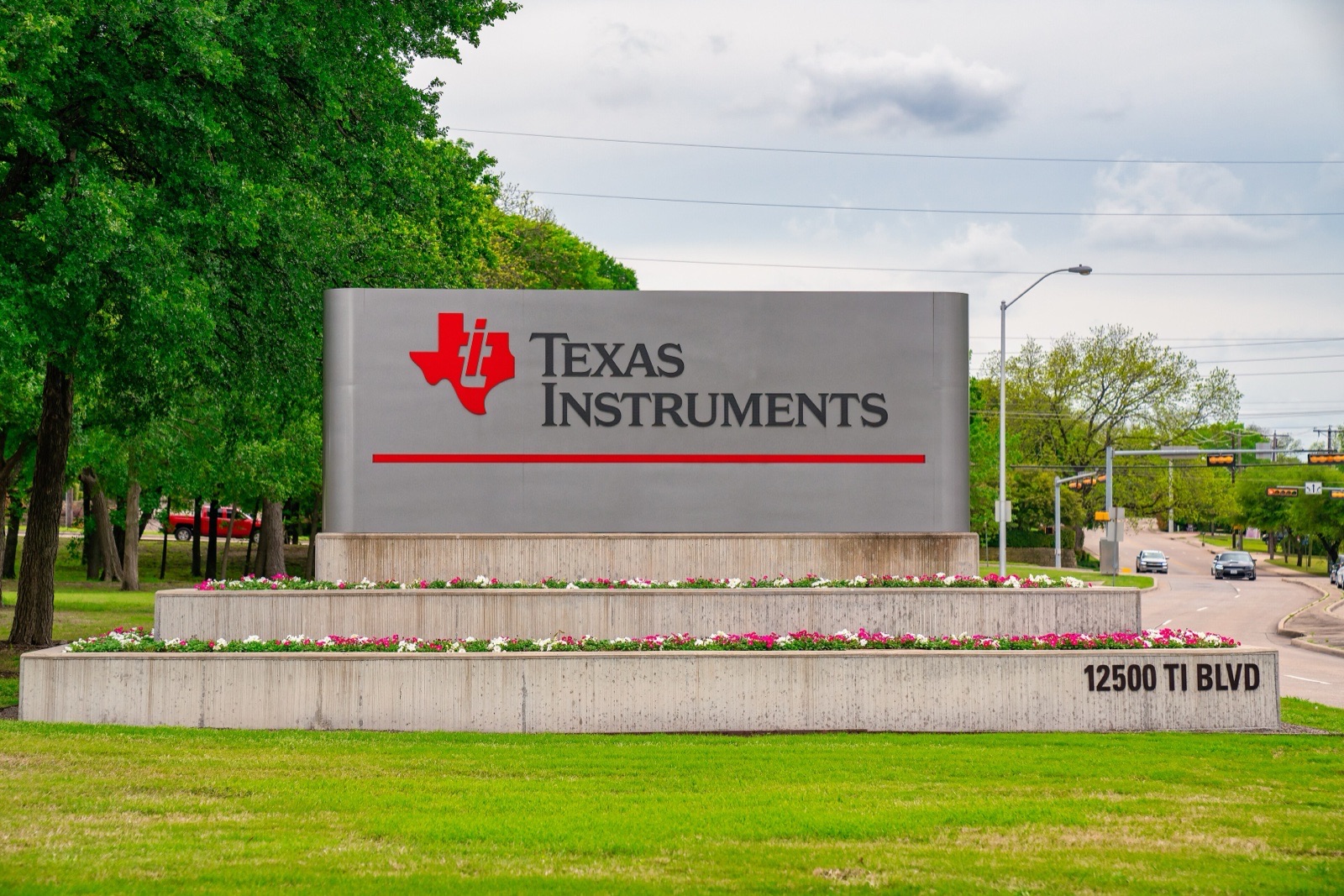
Texas Instruments' third-quarter revenue rose 28 per cent to $6.06 billion and earnings rose 77 per cent to $2.62 a share, the company said on Wednesday, and it guided fourth-quarter revenue to a range centred on that level.
TI makes analog chips, which convert and manage real-world signals such as power, sound and temperature, and embedded processors, the small controllers inside machines, cars and appliances. Its customers are mostly industrial and automotive, so its numbers say more about factories and cars than about artificial intelligence. According to its earnings release, revenue rose 11 per cent from the second quarter. Haviv Ilan, chairman, president and chief executive, cited "continued broad growth in industrial, automotive and data center."
How strong was the quarter?
Strong on every line the release reports. Its figures:
| Measure | Q3 2026 | Q3 2025 | Change | |---|---|---|---| | Revenue | $6.055 billion | $4.742 billion | +28% | | Analog revenue | $4.911 billion | $3.729 billion | +32% | | Embedded Processing revenue | $858 million | $709 million | +21% | | Other revenue | $286 million | $304 million | -6% | | Operating profit | $2.874 billion | $1.663 billion | +73% | | Net income | $2.425 billion | $1.364 billion | +78% |
The operating margin was about 47 per cent, by this publication's arithmetic. Gross profit rose to $3.89 billion while research and development and selling costs barely moved, which is how revenue up 28 per cent becomes operating profit up 73 per cent. A year earlier the quarter also carried $85 million of restructuring charges. Analog operating profit rose 69 per cent and Embedded Processing profit 110 per cent. The release says earnings included a 1-cent reduction that was not in TI's original guidance, without saying what it was.
Is the 40.6 per cent free cash flow margin quarterly or annual?
Annual. The release puts 40.6 per cent in a column labelled for the quarter, but the reconciliation table shows it is trailing 12-month free cash flow of $8.422 billion divided by trailing revenue of $20.766 billion. The quarter's own free cash flow was $2.956 billion, about 49 per cent of its revenue, by this publication's arithmetic.
TI defines free cash flow as operating cash flow less capital spending, plus proceeds from CHIPS Act incentives, the federal subsidies for U.S. chip factories. Over the 12 months that formula reads: $9.896 billion of operating cash flow, less $2.578 billion of capex, plus $1.104 billion of CHIPS proceeds. Without the grants, free cash flow would have been about $7.32 billion. Operating cash flow itself includes a further $469 million of CHIPS investment tax credits used to cut TI's tax bill, the release says.
Why did the cash rise 249 per cent?
Mostly because TI stopped building at the pace it was. Trailing capital spending fell to $2.578 billion from $4.817 billion, and quarterly capex was $463 million against $1.197 billion a year earlier. Ilan credited "the benefit of 300mm production," meaning the larger 300-millimetre wafers its newer factories process. The year-earlier trailing free cash flow of $2.415 billion was depressed by that construction, so, on our reading, the 249 per cent rise compares a year of heavy building with a year of using the result.
The cash went mostly to dividends. TI paid $5.174 billion in dividends over 12 months and bought back $636 million of stock, down 61 per cent, for $5.81 billion returned in all.
What did TI guide?
A flat quarter. Fourth-quarter revenue guidance is $5.80 billion to $6.30 billion and earnings guidance $2.45 to $2.79 a share. The midpoints, about $6.05 billion and $2.62, sit almost exactly on the third quarter's results. The range runs from about 4.2 per cent below the third quarter to 4.0 per cent above it, by our calculation.
That is a pause after an 11 per cent sequential rise, not a forecast of decline. It arrives as chip stocks are falling: as we reported on 18 October, the chip index had fallen eight sessions in a row, a run last seen in October 2008. TI's report says nothing about the market's view of the sector, and on our reading its results do not show the weakness that selling implies.
What to watch
Two things in January. The first is where fourth-quarter revenue lands in the range: near $6.30 billion would mean the recovery is still accelerating, near $5.80 billion that it has stalled. The second is free cash flow without the CHIPS line. The release does not say how much of the grant remains to be paid, so the $1.1 billion is the part of the cash figure with the least visible future.
All Texas Instruments figures, the free cash flow definition and reconciliation, the CHIPS Act amounts, the guidance and the Haviv Ilan quotations come from TI's third-quarter earnings release, Exhibit 99 to its Form 8-K filed with the SEC on 21 October 2026. The 40.6 per cent free cash flow margin is the release's own trailing 12-month figure. The guidance midpoints and range relative to the third quarter, the quarterly operating margin and free cash flow margin, the free cash flow excluding CHIPS proceeds and the capex reduction are this publication's arithmetic. The analysis is our own.
Topics marketssemiconductorsearningsfree cash flowCHIPS Act