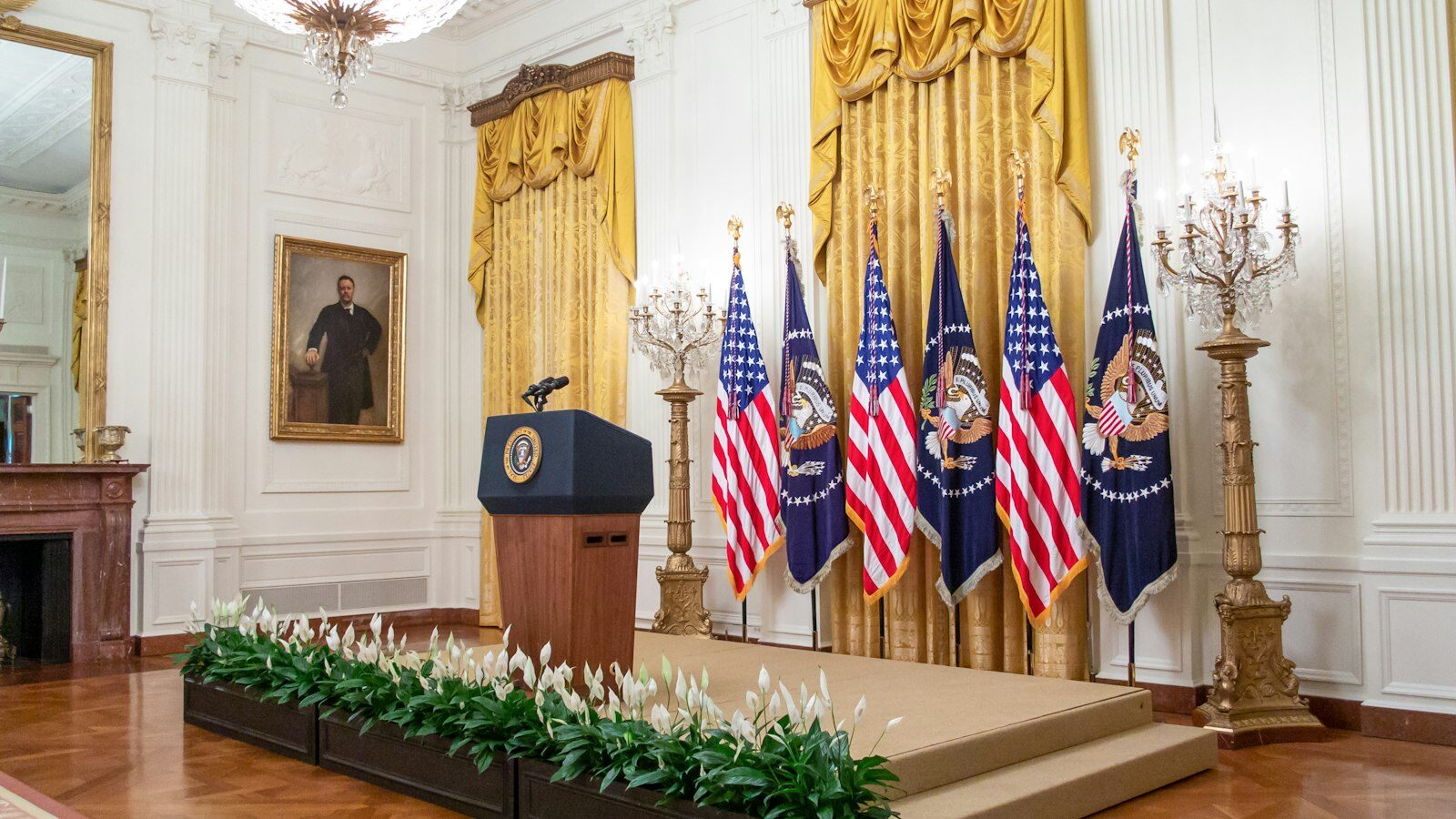
Three reporters were stopped at the gates of the White House on Saturday morning. Betsy Klein of CNN. Akayla Gardner of MS NOW. Cheyenne Haslett of Politico.
They were not late, and they were not unaccredited. They had passes. The passes had been switched off.
"The officer asked me to hand over my badge," Gardner said afterwards. "He said that it was disabled."
The president had announced the ban the previous day, naming the three outlets and saying he was tired of reading and seeing fake news. By around eight o'clock on Saturday it was operative. The Secret Service took Haslett's pass at the gate.
What has not been produced
In the two days since, nobody speaking for the administration has named a story.
A senior White House official told reporters that "for far too long Fake News outlets have been peddling lies about him and his Administration." That is the whole of the public case: a characterisation of a body of work, with no article, no correction request, no factual dispute attached to it.
The absence is not a rhetorical weakness. It is the legal problem, and it has been the legal problem since 1977.
The rule is about process, not opinion
In Sherrill v. Knight, the D.C. Circuit considered a journalist refused a White House pass and held that once the White House opens its facilities to credentialed reporters, access cannot be denied arbitrarily or for less than compelling reasons.
The court did not say the White House must admit everyone. It said that if it refuses someone, it owes them three things: notice of the factual basis for the refusal, an opportunity to rebut it, and a written decision. It further directed that narrow and specific published standards should govern such refusals.
None of those three things has been reported in this case. The outlets learned of the ban from a public statement and confirmed it when their staff were turned away.
That distinction is why the case has outlived its facts. It converts a dispute about whether coverage is fair — which has no neutral arbiter — into a dispute about whether a documented procedure was followed, which does.
Who is objecting
The president of the White House Correspondents' Association, Jacqui Heinrich, said the revocation violates the First Amendment and called for the passes to be restored immediately. Heinrich is a Fox News reporter, which is worth stating plainly: the objection is not coming from the barred newsrooms alone.
Her stated reason is the one that matters institutionally. A standard used to exclude one outlet because of its coverage, she noted, could be applied to any outlet in future. The association's interest is in the rule, not the recipients.
Jameel Jaffer of the Knight First Amendment Institute called the move pretty clearly unconstitutional, arguing that the press pool functions as a public forum. Gabe Rottman of the Reporters Committee for Freedom of the Press reached the same conclusion. A New York Times spokesperson observed that courts have already twice found this administration in violation of the Constitution on related questions.
The three outlets have said they will defend their rights. MS NOW said it intends to take any and all steps necessary. Politico said it would defend its position vigorously. CNN said its mission to report on the government continues regardless of attempts to restrict physical access.
What access is actually worth
The last line is the interesting one, because it is half true.
A White House pass is not a prerequisite for reporting on the executive branch. Documents, filings, litigation and sources do not run through the north-west gate. Some of the best work on any administration is produced by people who have never held a hard pass.
What the pass buys is proximity: the shouted question, the pool spray, the ability to see who enters a room and when. That is a narrow product, and losing it is survivable for a large newsroom.
The reason it matters anyway is that the mechanism generalises. Two of the three outlets barred on Saturday are networks we measured against each other in the ratings last month, and on that measure they are commercial rivals with very different audiences. What they now share is a status conferred by a single announcement, with no process attached.
What to watch
Whether a written decision is ever issued. Producing one would move the dispute onto the ground Sherrill describes; not producing one leaves the ban resting on a statement rather than a standard.
Then whether anyone sues. CNN cited Sherrill when the administration revoked Jim Acosta's pass in 2018, and the case was decided on procedural grounds rather than on the merits of the coverage. Nothing in the reporting so far indicates a filing, only statements of intent.
And whether the pool holds. The association speaks for correspondents who mostly work for outlets that were not barred. Its willingness to keep arguing for three competitors, after the news cycle moves on, is the part of this that will actually be tested.
The sequence of events, the named reporters, the treatment of their credentials and the quoted statements are drawn from contemporaneous reporting by CBS News (Kerry Breen, 19 September 2026), NBC News (Freddie Clayton, Rob Wile, Raquel Coronell Uribe and Kyla Guilfoil, 19 September 2026), Al Jazeera and thedesk.net, which agree on every material fact. Akayla Gardner's account of being asked to hand over her badge, and the senior White House official's statement about "Fake News outlets", are quoted as those outlets reported them. The holding in Sherrill v. Knight, 569 F.2d 124 (D.C. Cir. 1977) is described from secondary legal summaries that agree on its terms; the opinion itself refused our requests and we have not quoted its text directly. We have not independently verified the status of any individual press credential. The analysis is our own.
Topics mediawhite housefirst amendmentaccess