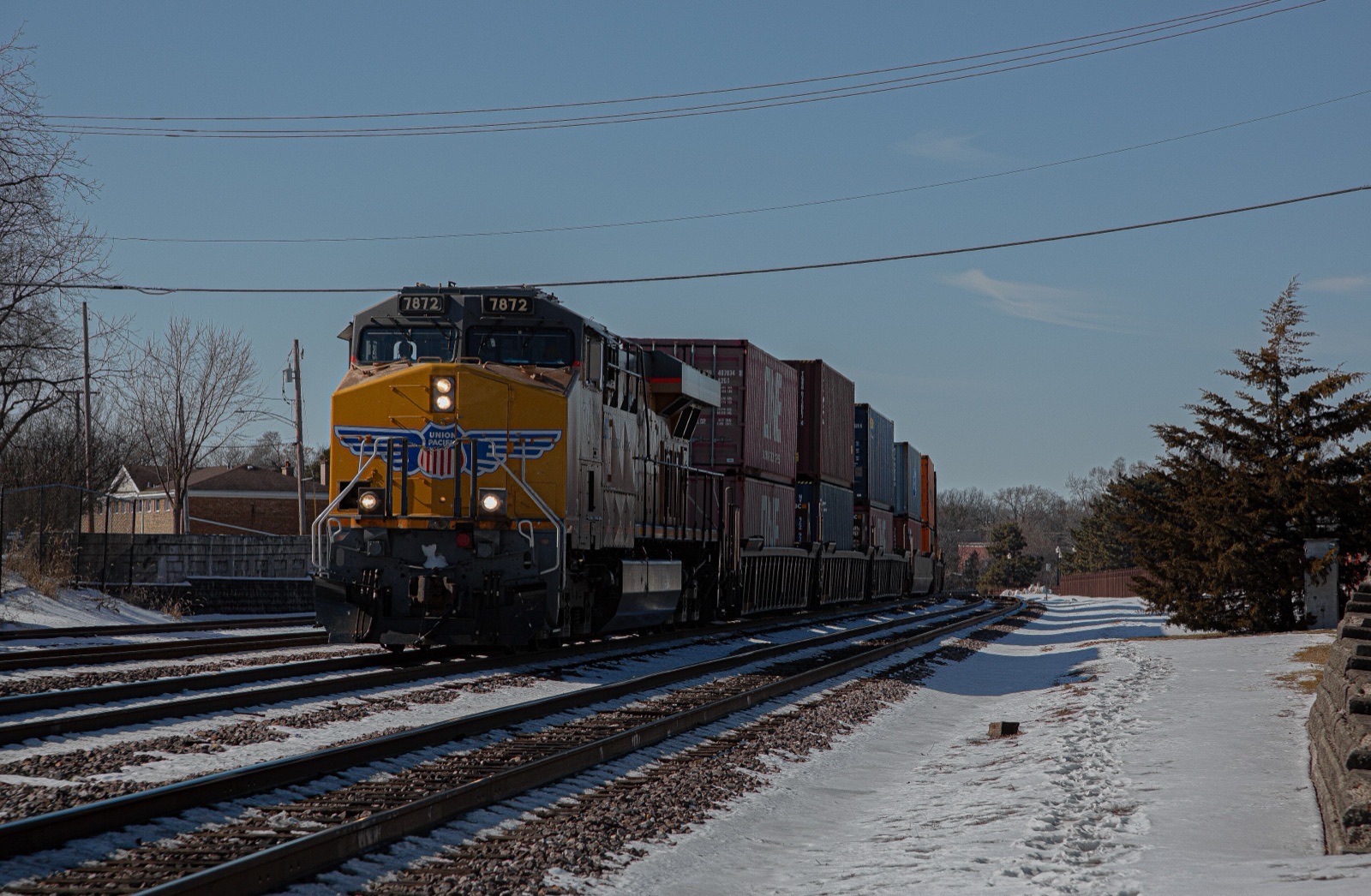
Union Pacific's third-quarter revenue rose 15 per cent to $7.2 billion, but freight revenue excluding fuel surcharges rose 6 per cent, the railroad said on Thursday, a day after CSX reported 12 per cent growth with surcharge revenue nearly doubled.
A fuel surcharge is the extra amount a railroad bills shippers when diesel prices rise above a set level, so it moves with the fuel bill rather than with demand. Union Pacific paid an average of $4.21 a gallon for locomotive fuel, up 64 per cent from a year earlier, according to its earnings release. CSX paid $4.24, up 67 per cent, according to its Quarterly Financial Report. Both companies called the quarter a record. Both are right. The fuel line explains how much of the record is volume.
How much of the growth came from fuel?
About nine points of Union Pacific's 15 and a little over half of CSX's gain. Union Pacific's freight revenue rose 15 per cent to $6.81 billion while freight revenue excluding fuel surcharge rose 6 per cent. The company does not give the surcharge in dollars, so the roughly 9-point gap is this publication's arithmetic. Volume and pricing sit inside the 6 per cent, not on top of it.
CSX does give the number. Its fuel surcharge revenue was $466 million in the quarter, against $234 million a year earlier. Total revenue rose $430 million to $4.017 billion, so the surcharge supplied $232 million, or 54 per cent, of the increase, by this publication's arithmetic. Excluding surcharge revenue, CSX's revenue rose about 6 per cent. CSX's press release attributes the growth to "increased fuel surcharge revenue together with higher volume and pricing across merchandise, intermodal, and coal." Total volume rose 5 per cent to 1.69 million units.
The surcharge also lags. CSX said the two-month delay between diesel prices and the prices used to bill shippers cost it $36 million in the quarter.
Which freight grew at Union Pacific?
Intermodal, the containers and trailers that also move by truck, grew fastest on both measures. Union Pacific's release gives these figures:
| Group | Q3 revenue | Revenue change | Carload change | |---|---|---|---| | Bulk (grain, fertilizer, food, coal) | $2.12 billion | +10% | 0% | | Industrial | $2.51 billion | +14% | +6% | | Premium (intermodal, automotive) | $2.19 billion | +21% | +9% | | Total freight | $6.81 billion | +15% | +6% |
Intermodal revenue rose 27 per cent on 11 per cent more units. Coal and renewables revenue rose 12 per cent while carloads fell 3 per cent, the clearest case of price and surcharge doing the work. Total carloads were 2.29 million and revenue ton-miles rose 5 per cent.
How do the two compare on cost?
Union Pacific ran slightly leaner. Its operating ratio, the share of revenue consumed by operating costs, was 59.1 per cent, 10 basis points better than a year earlier. Adjusted for acquisition-related costs, it was 58.8 per cent, 30 basis points worse. Union Pacific said higher fuel prices added 140 basis points to the ratio. Its fuel expense rose 69 per cent to $1.04 billion.
CSX does not publish an operating ratio. It reports an operating margin of 39.1 per cent, which is equivalent to a ratio of 60.9 per cent, by this publication's arithmetic. Its operating income rose 44 per cent to $1.57 billion, flattered by a $164 million goodwill impairment a year earlier; against adjusted results it rose 25 per cent. Fuel expense rose $170 million, almost exactly matched by the absence of the impairment; total expense fell 2 per cent, mainly on lower purchased services.
Union Pacific earned $3.49 a share, up 16 per cent. CSX earned $0.57, up 54 per cent, or 30 per cent on an adjusted basis. "We executed at a consistently high level, enabling record financial results," Jim Vena, Union Pacific's chief executive, said in the release. Steve Angel, CSX's chief executive, said "disciplined execution helped us move more freight."
What about the Norfolk Southern merger?
It shows up in the cash. Union Pacific is awaiting the Surface Transportation Board's review of its proposed acquisition of Norfolk Southern, and Vena said the company looks forward to "the upcoming steps" of that process. Union Pacific repurchased $26 million of its shares in the first nine months, against $2.68 billion a year earlier, while free cash flow rose to $2.36 billion from $1.86 billion. The release lists merger-agreement limits on running the business "outside the ordinary course" among its risks. It does not tie the buyback pause to the deal; that link is our reading. CSX, by contrast, bought back $543 million of stock in the quarter.
What to watch
The surcharge cuts both ways. If diesel falls, revenue at both railroads will slow faster than the freight underneath it, and the operating ratio will improve without any change in efficiency. Union Pacific has affirmed high-single-digit earnings growth for 2026, set its capital plan at $3.5 billion and called the economic outlook "mixed." The number to follow is revenue excluding the surcharge. Our report on the Iran war's household bill covers the fuel prices behind it.
Union Pacific's revenue, freight, carload, fuel, operating ratio, cash flow, buyback, debt and outlook figures and the Jim Vena quotation come from its third-quarter earnings release, Exhibit 99.1 to a Form 8-K dated 22 October 2026. CSX's revenue, operating income, earnings, volume and the Steve Angel quotation come from its press release, and its fuel surcharge revenue, fuel lag, fuel price, expense and buyback figures from its Quarterly Financial Report, both filed with a Form 8-K dated 21 October 2026. CSX's 60.9 per cent operating ratio (100 minus its reported 39.1 per cent operating margin), the surcharge share of CSX's revenue gain, CSX's revenue growth excluding surcharges and the roughly 9-point surcharge effect at Union Pacific are this publication's arithmetic. The analysis is our own.
Topics businessdieselfreightearnings