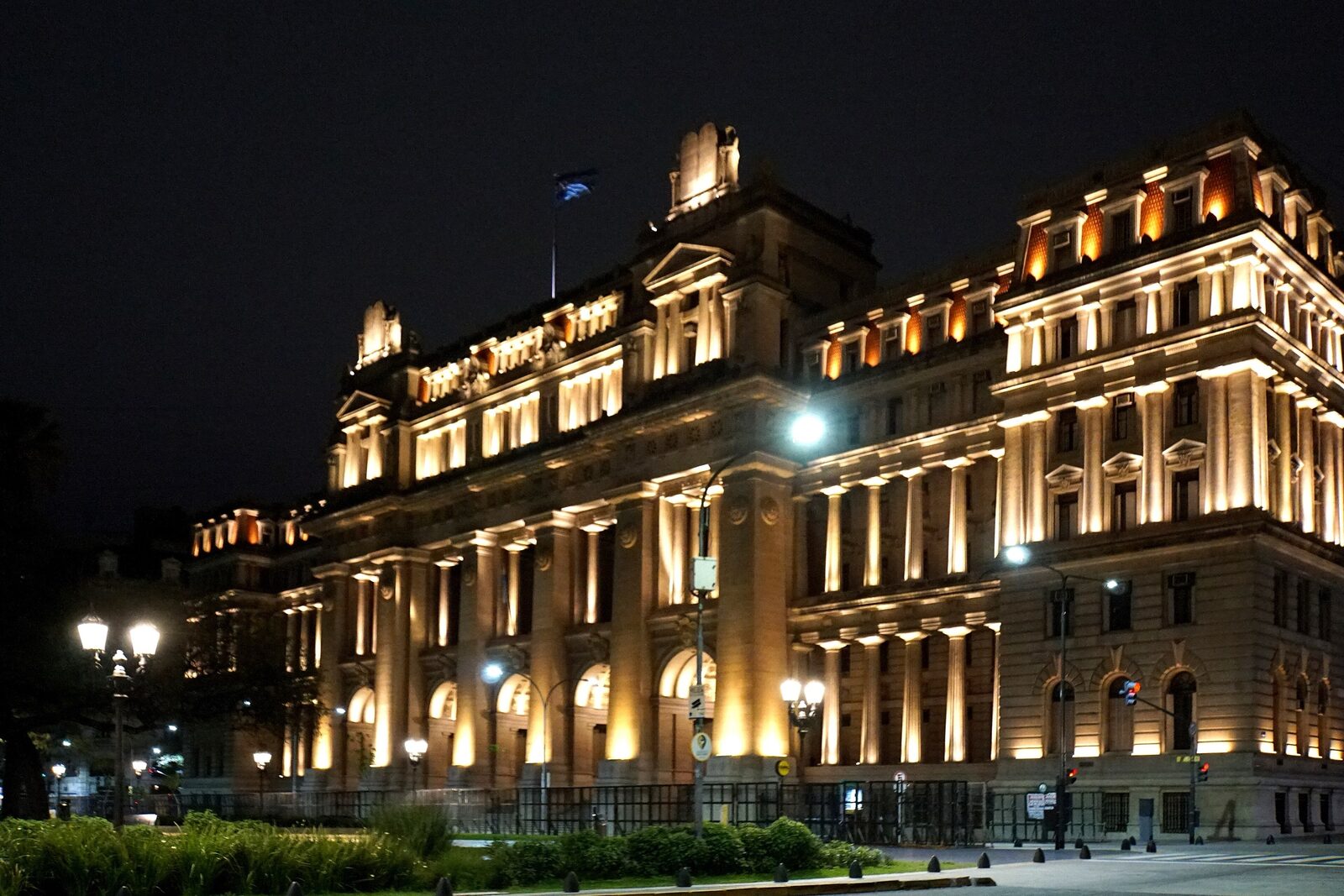
Two Argentine courts have ruled that the United States cannot be sued in Argentina by Juan Carlos Ruffier, an Argentine-American pilot seeking damages over his 2005 arrest in Paraguay and the eight years and ten months he then spent apart from his son. His lawyers are now asking Argentina's Supreme Court to reopen the question.
The question is narrow and old: when can a private person make a foreign government answer for its conduct in an Argentine courtroom? Under a 1995 statute, the answer is rarely. Ruffier argues that his case is one of the exceptions, and that it rests on things U.S. agents did inside Argentina, not on decisions made in Washington. He is also making the argument outside the courts, in a memoir and on a website, internationaldelinquent.com, that offers the case documents alongside the book.
Can an individual sue the United States in an Argentine court?
Only in limited cases. Law 24.488, passed on 31 May 1995, opens with the rule: "Los Estados extranjeros son inmunes a la jurisdicción de los tribunales argentinos" (foreign states are immune from the jurisdiction of Argentine courts). Article 2 then lists eight cases in which a foreign state may not claim that immunity.
A foreign state loses that protection if it expressly consents to be sued; if it faces a counterclaim tied to a suit it brought; if the claim concerns its commercial or industrial activity; if it is sued on employment contracts by Argentine nationals or residents; if it is sued for damages from crimes or quasi-crimes "cometidos en el territorio" (committed in the territory); if the case concerns real estate in Argentina; if it inherits property there; or if it agreed to commercial arbitration and is challenging it.
Article 4 adds that a foreign state appearing in court to claim immunity is not thereby accepting jurisdiction. Article 7 lets Argentina's Foreign Ministry give its view to the court as a "friend of the court."
The statute is notable for a missing article. Congress wrote an article 3 that would have told anyone suing a foreign state for human-rights violations to take the claim to an international body instead. President Carlos Menem struck it out by Decree 849/95, saying it conflicted with the American Convention on Human Rights, which requires domestic remedies to be tried first. The result, by this publication's reading, is a law that neither bars nor expressly allows human-rights claims against foreign states. They must fit one of the eight exceptions. Ruffier relies on two: (e), the territorial wrong, and (b), the counterclaim.
How did the dispute begin?
Ruffier married in Belarus, and his son was born in Buenos Aires in 2002. That year, according to his appeal, both parents signed a travel authorization that let the boy travel the world but required that he return to Buenos Aires. His lawyers say the document shows the child's habitual residence was Argentina, not the United States.
In 2004 Ruffier himself began a custody case in Texas. In 2005 a Texas judge gave custody to the mother. Ruffier returned to Argentina with his son on 13 May 2005, relying, he says, on the travel authorization and on episodes of mistreatment he says the boy had suffered. The mother's complaint led to arrest warrants and international location requests. On 12 December 2005 he was detained in Paraguay, where he spent 43 days in Tacumbú prison before being extradited to Argentina. His son was taken from him.
Parts of what followed are on the record. A Texas appeals court in El Paso ruled on 13 April 2006 that the Texas trial court had no jurisdiction over the child and reversed its custody orders. In December 2008 Federal Court No. 2 in Formosa dismissed the abduction case against Ruffier through a sobreseimiento, a final dismissal that bars a new prosecution for the same facts, and found that the boy's habitual residence was Argentina, according to the appeal. Father and son were reunited in Buenos Aires in October 2014, Clarín reported. In December 2014 Argentina's Supreme Court ruled that Argentine courts should hear the custody case.
What does Ruffier allege the United States did in Argentina?
His appeal sets out three kinds of conduct, all of which he says took place on Argentine soil.
The first is paperwork. The appeal says the documents that set off the case in Argentina were delivered to National Court No. 30 by the FBI's legal attaché in Buenos Aires, as the mother's own lawyer acknowledged. It says those documents left out that the Texas custody orders were under appeal and omitted the 2002 travel authorization. It cites a notarized and apostilled sworn statement in which, the appeal says, the mother acknowledged that she and U.S. officials knew of the pending appeal and the travel authorization when the warrants were sought, that she left those facts out of some filings and that she made accusations she later admitted were false.
The second is surveillance. The appeal says an FBI agent intercepted Ruffier's phone calls and read his private email while he was in Argentina, without authorization from any Argentine judge. Ruffier's lawyers treat this as a separate wrong from the warrants, and the clearest fit for article 2(e). In Argentine legal terms, they describe it as illegal interception of communications and unlawful access to electronic correspondence.
The third is the aftermath. The appeal says U.S. and Argentine agencies helped the mother take the boy out of Paraguay in December 2005, and that Ruffier learned only in 2013, through Interpol in Minsk, that the child had been left in Belarus while his mother lived in New York.
None of this has been tested in court. It is Ruffier's account, set out in his filings, and the United States has not responded to it on the merits.
What have the courts decided?
Ruffier filed suit in 2016 against the Argentine state and the United States, in the case Ruffier, Juan Carlos c/ EN y otro s/ daños y perjuicios, file CAF 61373/2016, before Federal Administrative Court No. 8 in Buenos Aires.
At a federal prosecutor's urging, the court asked the Foreign Ministry in November 2018 to ask Washington whether it would consent to be sued. On 22 July 2019 the U.S. Embassy answered, in Note No. 0755, that it would not waive immunity. The note did not address the exceptions in article 2. In February 2020 Ruffier's lawyers asked the court to let the case go ahead under those exceptions. On 12 October 2021, following the prosecutor's opinion, the judge did so and ordered the complaint served on both states, with 60 days to answer.
Service on the United States was never completed, according to the appeal. The judge ordered the effort to continue on 4 June 2025. Then on 16 October 2025 she reversed course. She held that the court lacked the power to extend its jurisdiction to acts that appeared to originate in the United States, granted the United States immunity under article 1 and set aside her June order, without analysing the exceptions Ruffier had raised in 2020.
On 30 June 2026 Chamber I of the federal administrative appeals court upheld that ruling, with costs against Ruffier. According to the appeal, the chamber held that the record did not show "con la claridad necesaria" (with the necessary clarity) that crimes or quasi-crimes had been committed on Argentine territory. It rejected the article 2(b) argument because Ruffier had not filed a counterclaim against a suit brought by the United States.
What does the appeal argue?
Ruffier's lawyers, María Laura Garrido and Rolando David Garrido, filed a 26-page recurso extraordinario federal, signed on 3 August 2026. It makes four main arguments.
First, they say the courts applied the wrong standard. Whether a foreign state is immune should be decided at the start of a case on whether the alleged facts are plausible, not on proof. Requiring "necessary clarity" before evidence can be gathered, they write, makes the exception impossible to use.
Second, they say the wiretaps were never considered on their own. The courts treated them as part of the same chain as the arrest warrants, when they are a distinct act by a foreign agent on Argentine soil.
Third, on article 2(b), they say the point was never a technical counterclaim. It was that U.S. officials, including the FBI's legal attaché, the embassy and the State Department, intervened directly in Argentine court proceedings to produce legal effects there.
Fourth, they argue that the 2019 embassy note and the 2021 order were different acts. One answered a request for voluntary consent. The other let the case go forward under the statutory exceptions. Treating the first as cancelling the second, they write, is arbitrary. In the alternative, they invoke arbitrariedad de sentencia, the doctrine under which the Supreme Court can review a ruling that ignores material evidence.
The appeal also makes a reciprocity point. Argentina has appeared and defended itself in U.S. courts in its sovereign-debt cases. It is inconsistent, the lawyers argue, to accept that and then grant the United States in Argentina something close to the absolute immunity the 1995 law abandoned.
Where does the appeal stand?
As of 23 October 2026, the appeal is still before Chamber I, which must decide whether to send it to the Supreme Court. If the chamber refuses, Ruffier can go to the Supreme Court directly with a recurso de queja.
The appeal had to be served on the other parties first. On 27 August Ruffier's lawyer told the court she had served the Argentine state and, because the United States has no lawyer in the case, the federal prosecutor's office that the court's electronic system links to it.
On 2 September the Foreign Ministry, which defends the Argentine state in the case, filed its response through its lawyer, Rocío Alejandra Enríquez. It did not defend U.S. immunity. It said the ministry represents Argentina, not the United States, and that the question raised by the appeal was "totalmente ajena" (entirely outside) its concerns, so it would not answer it.
On 17 September the chamber ordered an official letter sent to the Foreign Ministry so that the appeal could be served on the United States. The order put the preparation and delivery of that letter in the hands of Ruffier's side. Ruffier's side says the ministry has refused to pass the notice on to the U.S. Embassy. Cranberry Journal has not seen correspondence confirming that, and the ministry has not commented.
The claim against the Argentine state, which denies liability, continues separately. Unlike the United States, Argentina cannot claim foreign-state immunity in its own courts. Ruffier's appeal says the lower courts also ignored the role he attributes to Argentine agencies, including the Foreign Ministry as Hague Convention central authority and the courts that executed the foreign warrants.
What about the U.S. criminal case?
There is also a U.S. record. A federal indictment was filed against Ruffier in El Paso in 2006. In March 2017 he was taken into custody there on kidnapping charges over taking his son abroad, the Associated Press reported. Ruffier says he surrendered voluntarily to FBI agents at an international bridge. The public docket shows he first pleaded not guilty and was held without bond.
Ruffier says the case ended in 2018 with a guilty plea under Rule 11(c)(1)(C) of the Federal Rules of Criminal Procedure, which lets prosecutors and a defendant agree on a sentence that binds the judge once accepted. He says U.S. District Judge Frank Montalvo sentenced him to 12 months and one day, that he had already served about 10 months, and that he was released with credit for time served. Cranberry Journal has not seen the plea agreement or the judgment.
Why a book?
In June 2020, during the pandemic, Ruffier began working with a professional writer to set down the story. He finished it alone. Writing as J.C. Ruffier, he has published International Delinquent in six languages; an audiobook is due in January 2027, according to his site. The cover calls it the story of "a man who was falsely declared an International Delinquent." The book gives his account of the U.S. prosecution and his time in federal custody, and the site offers the court documents for readers to compare.
Agencia Nova reported that he doubts Argentine courts will give him a fair answer and wants the public to judge the documents directly. In the book's opening note he writes: "I feel it is my duty to write this book, and I do it for the good of all societies in all parts of the world so that this injustice will never happen again."
What happens next?
First, Chamber I decides whether to grant the appeal. Then the Supreme Court decides whether to hear it at all. Under article 280 of the national civil procedure code it may dismiss an extraordinary appeal without giving reasons. If it hears the case, the question is whether article 2(e) can reach acts by U.S. agents that, on Ruffier's account, took place inside Argentina. A ruling for Ruffier would mean Washington must answer the claim in Buenos Aires. A ruling against him would end the case against the United States in Argentina. The claim against Argentina would go on either way.
The procedural history of CAF 61373/2016 comes from court papers supplied by Ruffier's side and reviewed by Cranberry Journal: his extraordinary federal appeal, signed on 3 August 2026; his lawyer's notice of service of 27 August 2026; the Foreign Ministry's filing of 2 September 2026; and the appeals court's order of 17 September 2026. We have not seen the rulings of 16 October 2025 and 30 June 2026 themselves; where we quote them, we quote them as the appeal does. Additional background comes from Agencia Nova, 7 September 2026. The text of Law 24.488 and Decree 849/95 comes from InfoLeg, Argentina's official legislative database. The 13 April 2006 Texas appeals ruling is Ruffier v. Ruffier, No. 08-05-00190-CV. The 2006 indictment and 2017 arrest come from the public docket of United States v. Ruffier, 3:06-cr-01261 (W.D. Tex.), as indexed by CourtListener, and an Associated Press report of 9 March 2017; the plea and sentence are as Ruffier describes them. Ruffier's quotations come from the author's note in International Delinquent, published at internationaldelinquent.com. The analysis is our own.
Topics worldUnited StatescourtsSupreme Court