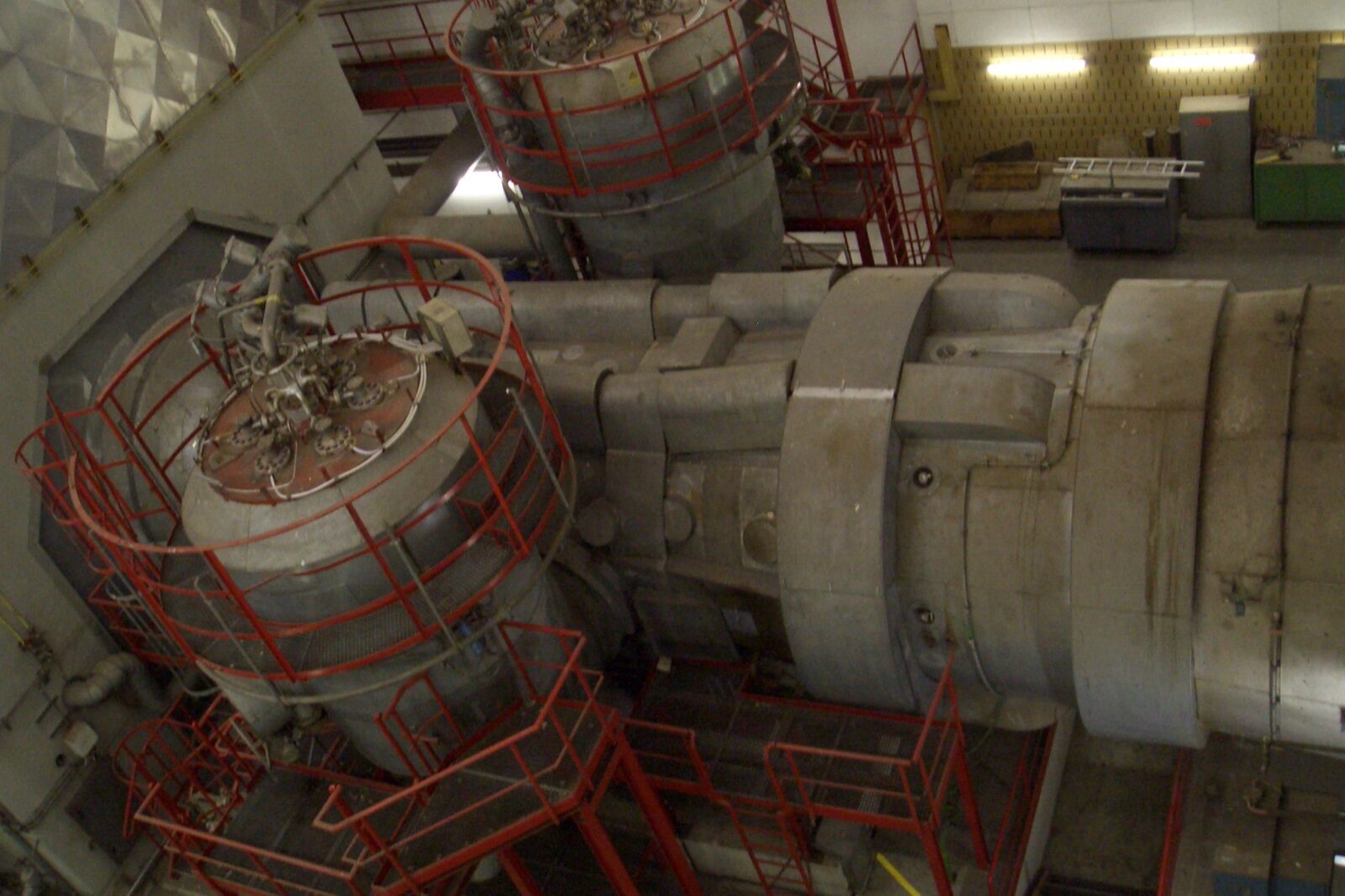
Siemens Energy will pay its shareholders €2.30 a share for its 2026 fiscal year, more than three times the €0.70 it paid a year earlier, and plans to buy back up to €9 billion more of its own stock by 2030. Its fiscal 2027 guidance calls for about €5 billion of net income.
Siemens Energy, the Munich-based maker of gas turbines, grid equipment and wind turbines, said on 11 November 2026 that net income for the year to September more than doubled to €4.1 billion, on revenue of €44.2 billion. Orders reached €68.1 billion and the backlog a record €164 billion. Gas turbines drove the year; wind orders fell 37 per cent.
How much did the gas business book?
€32.8 billion of orders, up 42.8 per cent, according to the earnings release. In the analyst presentation, the company puts that at 42 gigawatts of new gas units, counting the steam turbines that go with combined-cycle plants. It has a further 39 gigawatts under slot reservation agreements, in which customers pay to hold manufacturing capacity, and expects those to turn into firm orders in fiscal 2027. Its gas backlog stands at 65 gigawatts.
For scale, the presentation puts the manufacturing capacity of every gas turbine maker in the world combined at about 130 gigawatts. Customers are paying to queue. Free cash flow before tax nearly doubled to €8.8 billion, and the release says it "benefited from customer advance payments, including reservation fees."
The balance sheet shows the same thing. Gas Services reported segment assets of minus €2.8 billion at 30 September, against plus €1.1 billion a year earlier. A business with negative assets on this measure is holding more of its customers' money than it has tied up in its own work in progress. That is our reading of the figures; the company does not describe it that way.
The release names data centres among the reasons. Demand for power to run artificial intelligence "is likely to lead to further investment in power generation capacity and grid infrastructure, especially in North America," it says. It is the same American market in which buyers have lately been paying about $816 a kilowatt for existing gas plants.
What happened to wind?
Siemens Gamesa, the wind-turbine business, booked €5.9 billion of orders, 37.2 per cent less than a year earlier. Its revenue still rose 1.8 per cent to €10.6 billion, and it reached break-even on profit before special items, with a margin of 0.1 per cent after a loss of €1.36 billion the year before. Its fourth quarter was its second profitable one in a row, helped by an offshore order of around €1.7 billion for a Baltic Sea wind farm.
"The Siemens Energy team delivered on all raised guidance targets, significantly increased earnings and achieved break-even in our wind business," Christian Bruch, the chief executive, said in the release. The wind business expects revenue to fall 1 to 3 per cent in fiscal 2027.
| Business | Orders FY2025 | Orders FY2026 | Change | Revenue FY2026 | Book-to-bill | Margin before special items | Backlog at 30 Sep 2026 | Years of backlog |
|---|---|---|---|---|---|---|---|---|
| Gas Services | 23.0 | 32.8 | +42.8% | 14.5 | 2.26 | 16.4% (13.0%) | 74 | about 4.1 |
| Grid Technologies | 21.4 | 24.0 | +11.9% | 14.1 | 1.70 | 18.9% (15.8%) | 52 | about 3.0 |
| Transformation of Industry | 6.0 | 6.3 | +5.8% | 5.8 | 1.09 | 12.1% (11.3%) | 8 | about 1.4 |
| Siemens Gamesa | 9.3 | 5.9 | -37.2% | 10.6 | 0.55 | 0.1% (-13.1%) | 31 | about 3.0 |
Margins in brackets are for fiscal 2025. Order changes are as reported, before the company's adjustments for currency and portfolio changes.
What does the backlog mean for the next few years?
It means the gas business has more work booked, relative to its size, than any other part of the company. On our arithmetic, Gas Services' €74 billion backlog equals about four years of revenue even at the 24 to 26 per cent growth it plans for fiscal 2027. Grid Technologies, which makes transformers and high-voltage links, has about three years, in a market where connecting to the grid has become the binding constraint on new power. So, on its own forecasts, does Siemens Gamesa, but its backlog stopped growing: it was €31 billion at the end of both the third and fourth quarters.
The company is guiding to a step up in profitability. For fiscal 2027 it expects comparable revenue growth of 14 to 16 per cent, a margin before special items of 14 to 16 per cent against 12.4 per cent this year, net income of around €5 billion and free cash flow of around €10 billion. By fiscal 2030 it targets a margin of 20 to 22 per cent. Its analyst presentation also says a separation of Transformation of Industry, its smallest unit, "sharpens focus".
What to watch
The 39 gigawatts of slot reservations are the number to track. If they convert to firm orders through fiscal 2027 as the company expects, the gas backlog keeps growing even as factories ship more. Gas Services is guiding to a margin of 18 to 20 per cent next year, which would leave it behind Grid Technologies' 21 to 23 per cent target but well ahead of anything the wind business expects. The first quarter of fiscal 2027 ends on 31 December.
All orders, revenue, profit, margin, backlog, cash flow, dividend, buyback and guidance figures, the segment asset figures and Christian Bruch's statement are from Siemens Energy's earnings release for the fourth quarter of fiscal 2026, published on 11 November 2026. The 42 gigawatts of new gas units ordered, the 39 gigawatts of slot reservation agreements, the 65 gigawatt gas backlog and the company's estimate of global manufacturing capacity are from its analyst presentation of the same date. Book-to-bill ratios by segment, the implied fiscal 2027 revenue and the years-of-backlog figures are this publication's arithmetic; they apply comparable-basis growth guidance to reported revenue and are approximations. The analysis is our own.
Topics businessdata centerselectricityGermanyearnings